Percentage Calculator
To find a percentage of a number, divide the percent by 100 and multiply: 15% of 80 = 0.15 × 80 = 12. To find what percent one number is of another, divide the part by the whole and multiply by 100, so 33 out of 40 = 82.5%.
This calculator handles six common percentage questions and shows each step, so you can check the math or learn the method.
How to use the Percentage Calculator
- Choose what you want to find: % of a number, X is what % of Y, X is P% of what, % change, Increase / decrease, or % difference.
- Type your numbers. You can include commas (1,350), decimals (7.25) and negative values where they make sense.
- Press Calculate. The answer appears with the steps used to get it, and it updates as you edit the numbers.
- Use Copy result to paste the answer into a spreadsheet, homework file or message.
Percentage formulas
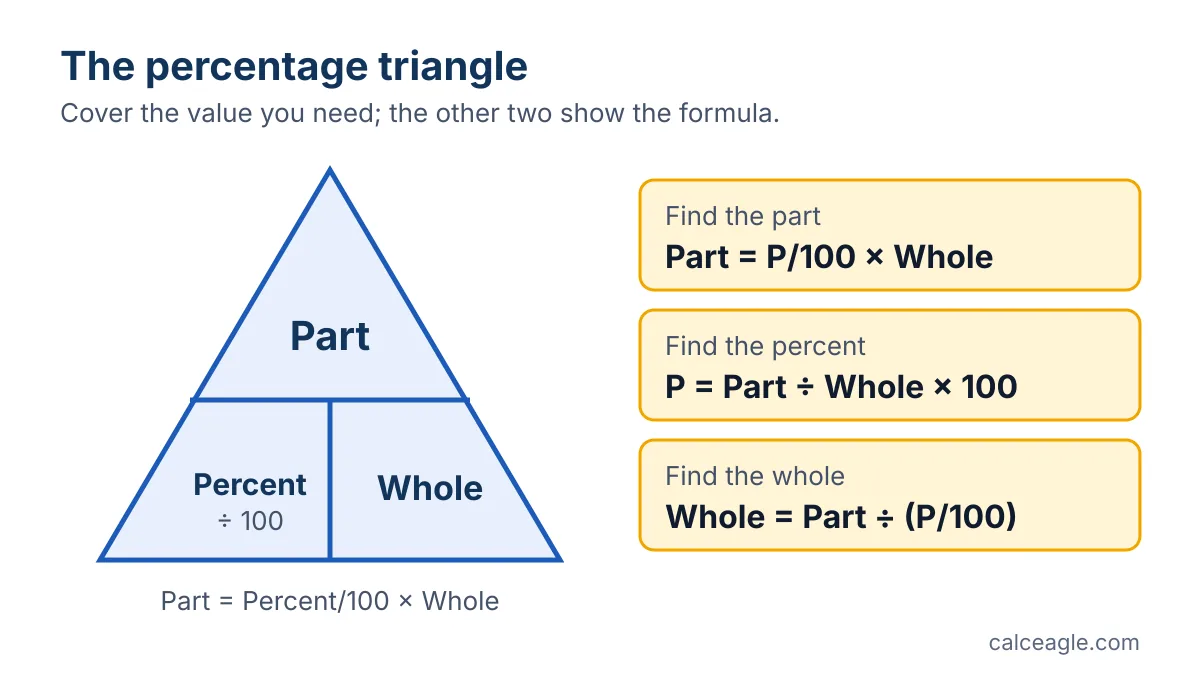
A percent is a ratio out of 100, so 15% means 15 ÷ 100 = 0.15. Every mode of the calculator is a rearrangement of the same relationship:
| Term | Meaning |
|---|---|
| Part | The portion you have, such as 33 correct answers |
| Whole | The total the part is compared with, such as 40 questions |
| Percent | The part expressed per 100 |
| Original / New | The before and after values in a change |
Examples
What is 15% of 80? Convert 15% to 0.15, then 0.15 × 80 = 12. This is the classic tip or discount question.
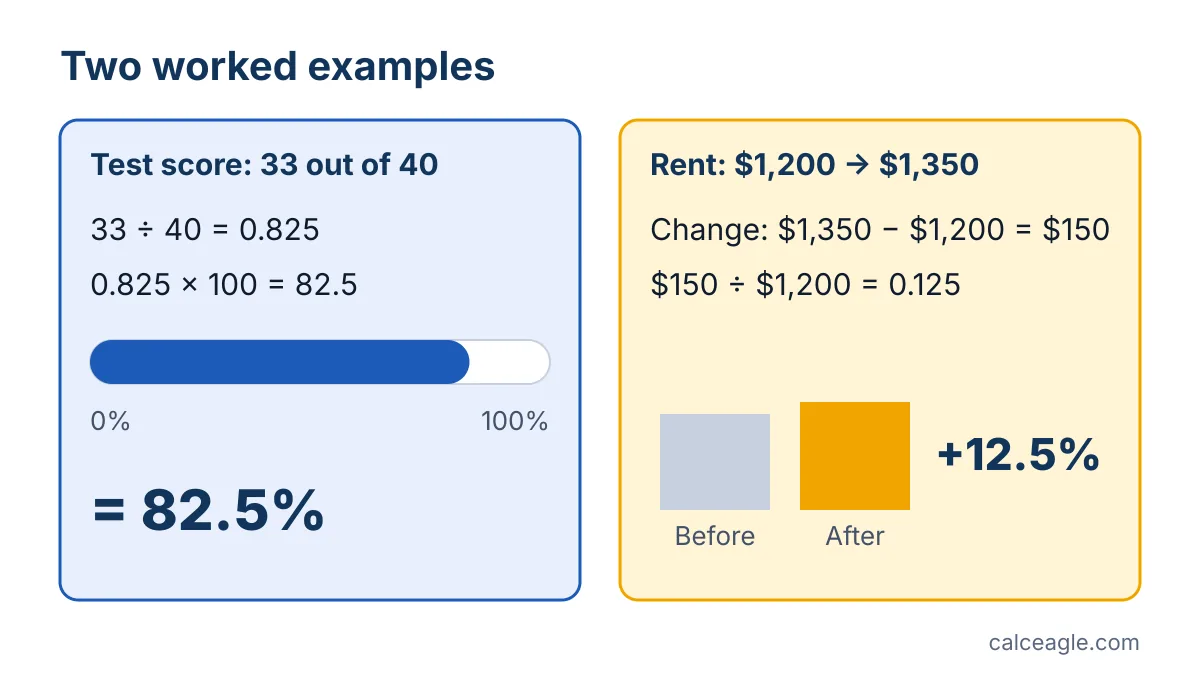
33 out of 40 as a percentage. Divide 33 by 40 to get 0.825, then multiply by 100: 82.5%. On the common 10-point scale used in many US schools that falls in the B range, but grading scales vary, so check your syllabus.
Rent increase. Rent rises from $1,200 to $1,350 a month. The change is $150, and $150 ÷ $1,200 = 0.125, so the increase is 12.5%.
Sale price. A $60 jacket is 20% off. Multiply $60 × (1 − 0.20) = $48. The discount is $12.
How to read the result
- A result above 100% in "X is what % of Y" means the part is larger than the whole you entered, for example 50 is 125% of 40.
- In % change, a positive number is an increase and a negative number is a decrease. A drop from 80 to 60 is −25%.
- Percentage points are not the same as percent. If a savings rate moves from 4% to 5%, it rose by 1 percentage point, which is a 25% relative increase.
Assumptions and limitations
- Percent change is measured against the absolute value of the original number, which keeps the sign meaningful when the original value is negative.
- Percent change is undefined when the original value is 0, and percent difference is undefined when the two values average to 0. The calculator tells you instead of showing a misleading number.
- Results are rounded for display (up to 4 decimal places for percentages). The copied text uses the same rounding.
Common mistakes
- Reversing a percent change with the same percent. A 20% decrease followed by a 20% increase does not return to the start: $100 → $80 → $96.
- Dividing by the wrong base. "What percent of 40 is 33?" divides by 40, not by 33.
- Adding percentages that use different bases. Two successive 10% raises are a 21% total increase, not 20%.
- Confusing percent change with percent difference. Use percent change when one value came first (before vs. after). Use percent difference when neither value is the reference, such as comparing two store prices.
Quick reference
| Question | Formula | Example |
|---|---|---|
| What is P% of Y? | P ÷ 100 × Y | 8.25% of $40 = $3.30 |
| X is what % of Y? | X ÷ Y × 100 | 18 of 24 = 75% |
| X is P% of what? | X ÷ (P ÷ 100) | 30 is 60% of 50 |
| % change from A to B | (B − A) ÷ A × 100 | 50 → 65 = +30% |
Need to add sales tax to a car price? Try the Out-the-Door Price Calculator. Working with averages of growth rates? The Geometric Mean Calculator gives the correct average percentage return.
Frequently asked questions
How do I calculate a percentage of a number?
Divide the percent by 100 and multiply by the number. For 15% of 80: 15 ÷ 100 = 0.15, and 0.15 × 80 = 12.
What is 33 out of 40 as a percentage?
33 ÷ 40 = 0.825, and 0.825 × 100 = 82.5%.
How do I calculate percent change?
Subtract the original value from the new value, divide by the original value, and multiply by 100. From 1,200 to 1,350: (1,350 − 1,200) ÷ 1,200 × 100 = 12.5%.
What is the difference between percent and percentage points?
Percentage points measure the simple difference between two percentages (4% to 5% is 1 point). Percent change measures the relative change (4% to 5% is a 25% increase).
Why doesn't a 20% increase undo a 20% decrease?
Each percent is applied to a different base. $100 minus 20% is $80; $80 plus 20% is $96. To get back to $100 from $80 you need a 25% increase.
Sources and references
- Percent — Merriam-Webster
- Percentages (Math is Fun) — Math is Fun
- Percentage Change — Math is Fun
Formulas and content last reviewed on October 13, 2026. Last updated October 13, 2026. Results are estimates for general information only. Spotted a problem? Tell us and we will check it.