Complex Number Calculator
A complex number has a real part and an imaginary part, written a + bi, where i² = −1. To multiply (3 + 4i)(1 − 2i), expand and replace i² with −1: the answer is 11 − 2i. The number 3 + 4i is 5 units from zero at an angle of about 53.13°, so its polar form is 5 ∠ 53.13°.
This calculator adds, subtracts, multiplies and divides complex numbers, and finds the conjugate, modulus, argument, polar form, whole-number powers and every nth root, with the steps shown.

How to use the Complex Number Calculator
- Choose an Operation. Add, subtract, multiply and divide use two numbers. Conjugate, modulus, argument, polar form, power and roots use only the first number, z₁.
- Enter z₁ as a Real part (a) and an Imaginary part (b). For 5 − 2i, enter 5 and −2. For a pure imaginary number such as 4i, enter 0 and 4. A blank part counts as 0.
- For a two-number operation, enter z₂'s Real part (c) and Imaginary part (d). For a power or root, enter n.
- Press Calculate. The answer appears in rectangular form (a + bi), polar form (r ∠ θ), exponential form (r·e^(iθ)) and trigonometric form, with the modulus, the angle and the steps. For roots, every root is listed in a table.
Complex number formulas
A complex number z = a + bi has a real part a and an imaginary part b, where i² = −1.
| Symbol | Meaning |
|---|---|
| a, b | Real and imaginary parts of z₁ |
| c, d | Real and imaginary parts of z₂ |
| r | Modulus: the distance from 0 on the complex plane |
| θ | Argument: the angle from the positive real axis |
| n, k | The power or root, and the index of each root |
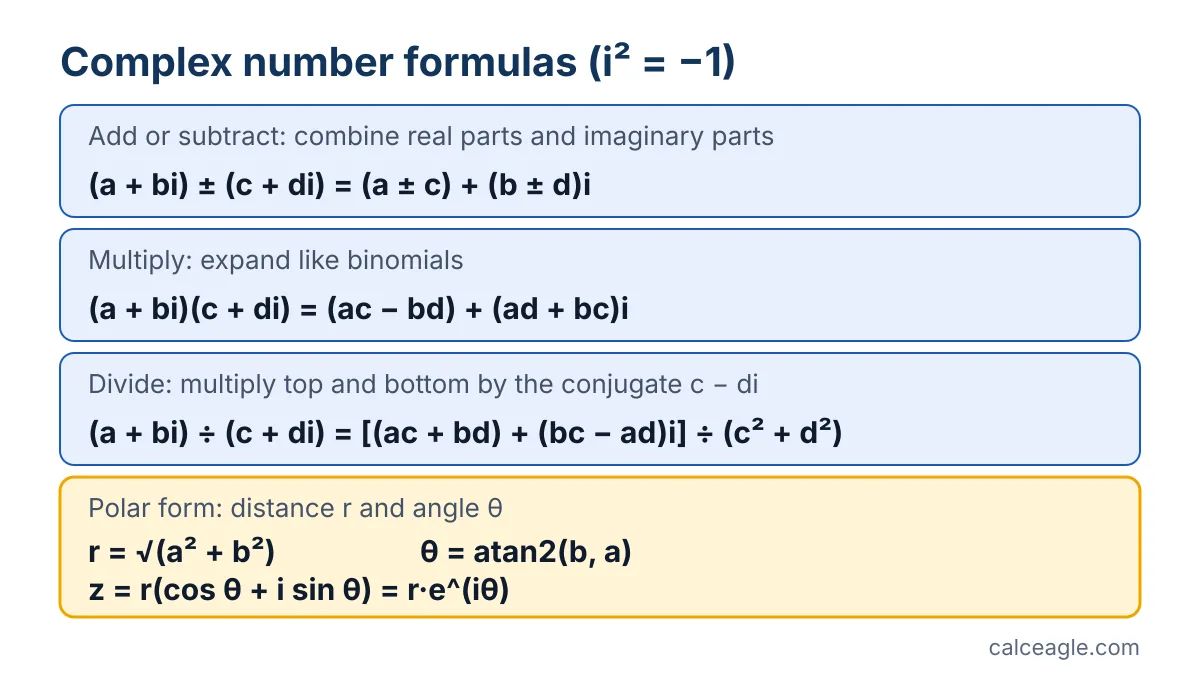
Adding and subtracting work part by part. Multiplying is like multiplying two binomials, with i² replaced by −1. Dividing works by multiplying the top and bottom by the conjugate of the denominator, which turns the denominator into the real number c² + d². The modulus and argument describe the same point as a distance and an angle; the principal argument is the one between −180° and 180° (−π and π radians). Powers and roots are easiest in polar form: raise r to the power and multiply the angle, or take the root of r and divide the angle.
Example: multiply, divide and convert 3 + 4i
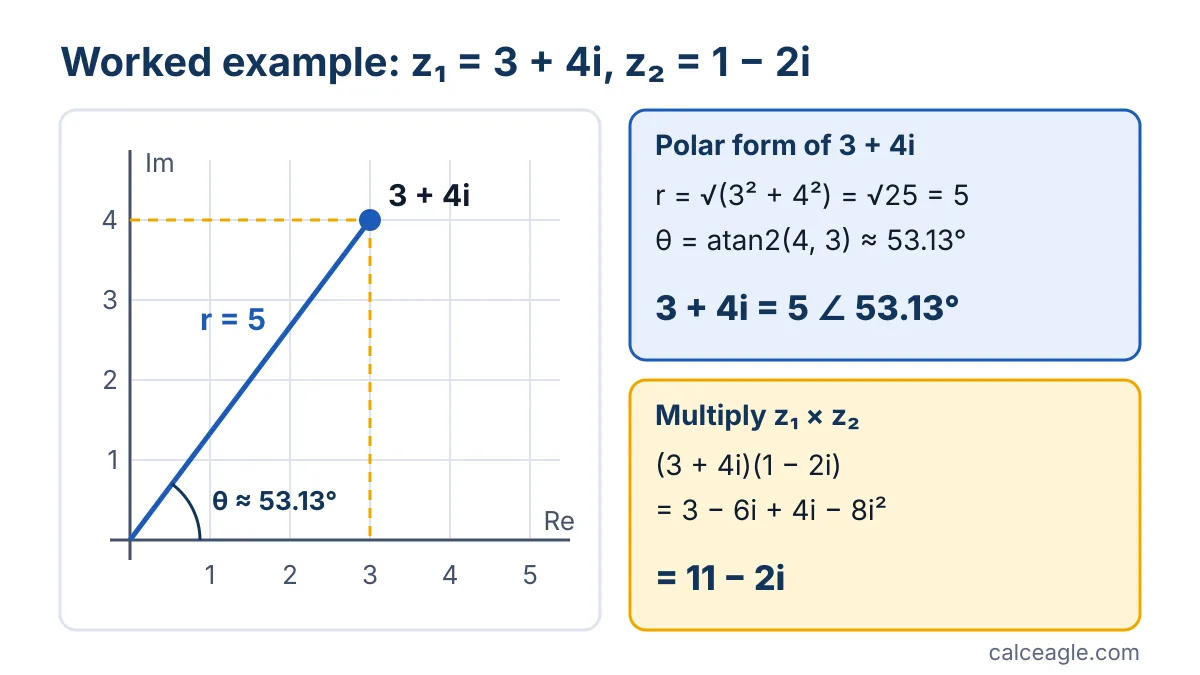
Let z₁ = 3 + 4i and z₂ = 1 − 2i.
Multiply. (3 + 4i)(1 − 2i) = 3 − 6i + 4i − 8i² = 3 − 2i + 8 = 11 − 2i.
Divide. Multiply the top and bottom by the conjugate of z₂, which is 1 + 2i:
- Top: (3 + 4i)(1 + 2i) = 3 + 6i + 4i + 8i² = −5 + 10i
- Bottom: 1² + 2² = 5
- Result: (−5 + 10i) ÷ 5 = −1 + 2i
Check by multiplying back: (−1 + 2i)(1 − 2i) = −1 + 2i + 2i − 4i² = 3 + 4i.
Polar form. r = √(3² + 4²) = √25 = 5, and θ = atan2(4, 3) ≈ 53.130102°, which is 0.927295 radians. So 3 + 4i = 5 ∠ 53.13° = 5·e^(0.927295i).
Example from an AC circuit
Electronics uses the same math but usually writes j instead of i. Ohm's law still holds for alternating current when voltage, current and impedance are all written as complex numbers: I = E ÷ Z. Suppose a 120-volt source drives a load with an impedance of Z = 3 + 4j ohms. Choose Divide, enter z₁ = 120 + 0i and z₂ = 3 + 4i:
I = 120 ÷ (3 + 4j) = 120(3 − 4j) ÷ 25 = 14.4 − 19.2j amps
In polar form that is 24 ∠ −53.13°: a 24-amp current whose angle is 53.13° behind the voltage.
How to read the result
- Rectangular form, a + bi, gives the real and imaginary parts. It is the easiest form for adding and subtracting.
- Polar form, r ∠ θ, gives the distance and the angle in degrees. Multiplying in polar form is simple: multiply the r values and add the angles.
- Exponential form, r·e^(iθ), is the same point with θ in radians, using Euler's formula e^(iθ) = cos θ + i sin θ.
- Argument is shown in degrees, radians and as a multiple of π (0.5π is 90°). The argument mode also gives the angle from 0° to 360°, since −90° and 270° point the same way.
- Values are rounded to 6 decimal places. Leftovers from rounding, such as 1.2 × 10^−16 from cos 90°, are shown as 0.
Assumptions and limitations
- Angles are principal values between −180° and 180°. Some textbooks prefer 0° to 360°; both describe the same number.
- Powers must be whole numbers from −1,000 to 1,000, and roots from 2 to 100. 0⁰ is taken as 1.
- Division by 0 + 0i, the argument of 0, and 0 raised to a negative power are undefined. The calculator says so instead of showing a number.
- The math uses standard double-precision numbers, accurate to about 15 significant digits. Whole-number powers are computed by repeated multiplication, so (1 + i)⁸ comes out as exactly 16.
- The principal root (k = 0) is the one most software returns, but all n roots are equally valid solutions of wⁿ = z. For everyday real-number arithmetic, the Basic Calculator is simpler.
Common mistakes
- Forgetting that i² = −1. In (3 + 4i)(1 − 2i), the −8i² term becomes +8, not −8.
- Choosing the wrong quadrant. tan⁻¹(b ÷ a) alone gives 45° for both 1 + i and −1 − i. atan2(b, a) uses the signs of both parts and correctly gives 45° and −135°.
- Dividing part by part. (a + bi) ÷ (c + di) is not (a ÷ c) + (b ÷ d)i. Multiply by the conjugate instead.
- Mixing degrees and radians. e^(iθ) needs θ in radians, so 53.13° becomes 0.927295. Converting between the two also comes up in the Area of a Sector Calculator.
- Putting the sign in the wrong field. For 5 − 2i, the imaginary part is −2, not 2.
Frequently asked questions
What is i in a complex number?
i is the imaginary unit, defined by i² = −1. A complex number a + bi combines a real part a with an imaginary part b. Electronics often writes j instead of i.
How do you divide complex numbers?
Multiply the top and bottom by the conjugate of the bottom number, then simplify. For (3 + 4i) ÷ (1 − 2i), multiply by 1 + 2i to get (−5 + 10i) ÷ 5 = −1 + 2i.
How do I convert a complex number to polar form?
Find the modulus r = √(a² + b²) and the angle θ = atan2(b, a). For 3 + 4i, r = 5 and θ ≈ 53.13°, so 3 + 4i = 5 ∠ 53.13° = 5(cos 53.13° + i sin 53.13°).
How many nth roots does a complex number have?
Every nonzero complex number has exactly n different nth roots. They have the same modulus and are spaced 360° ÷ n apart. For example, the cube roots of −8 are 1 + 1.732051i, −2 and 1 − 1.732051i.
Is the modulus the same as the absolute value?
Yes. The modulus |a + bi| = √(a² + b²) is the absolute value of a complex number: its distance from 0 on the complex plane. |5 − 12i| = 13.
Sources and references
- 2.4 Complex Numbers (College Algebra 2e) — OpenStax, Rice University
- §1.9 Calculus of a Complex Variable (Digital Library of Mathematical Functions) — National Institute of Standards and Technology
- Complex Number Primer: Powers and Roots — Paul's Online Notes, Lamar University
- 2.5: Polar Form and Rectangular Form Notation for Complex Numbers — LibreTexts (Kuphaldt, Electric Circuits II)
- R, L and C Summary — All About Circuits
Formulas and content last reviewed on October 13, 2026. Last updated October 13, 2026. Results are estimates for general information only. Spotted a problem? Tell us and we will check it.