Nether Portal Calculator
To convert Overworld coordinates to Nether coordinates, divide X and Z by 8 and round down; Y stays the same. Overworld X 1,250, Z −340 becomes Nether X 156, Z −43. To go back, multiply the Nether X and Z by 8.
This calculator converts in both directions using the game's round-down rule for negative numbers, shows how close an existing portal must be to link in Java and Bedrock, and plans a Nether highway between two Overworld locations.
How to use the Nether portal calculator
- Under What do you want to do? pick Convert coordinates for a single point, or Link two portals (highway) to plan a route between two Overworld places.
- For a single point, choose the Direction: Overworld → Nether or Nether → Overworld.
- Enter X, Y (optional) and Z. In Java Edition they appear on the F3 debug screen; in Bedrock Edition use the on-screen coordinates. Negative numbers and decimals are fine.
- Press Calculate. The large result is the block to build at. The table also shows the exact (unrounded) values, every Overworld block that maps to the same Nether block, and how far the game searches for an existing portal.
- For a highway, enter X and Z for Overworld location A and Overworld location B. You get the Nether coordinates for a portal at each place, the distance between them in both dimensions, and rough sprinting times.
Nether coordinate formula
Horizontal distances in the Nether are one-eighth of the Overworld's. The Minecraft Wiki gives the conversion as:
| Symbol | Meaning |
|---|---|
| X | East–west position (east is positive) |
| Z | North–south position (south is positive) |
| Y | Height. It is not scaled. |
| ⌊ ⌋ | Floor. 29.9 becomes 29, but −29.9 becomes −30. |
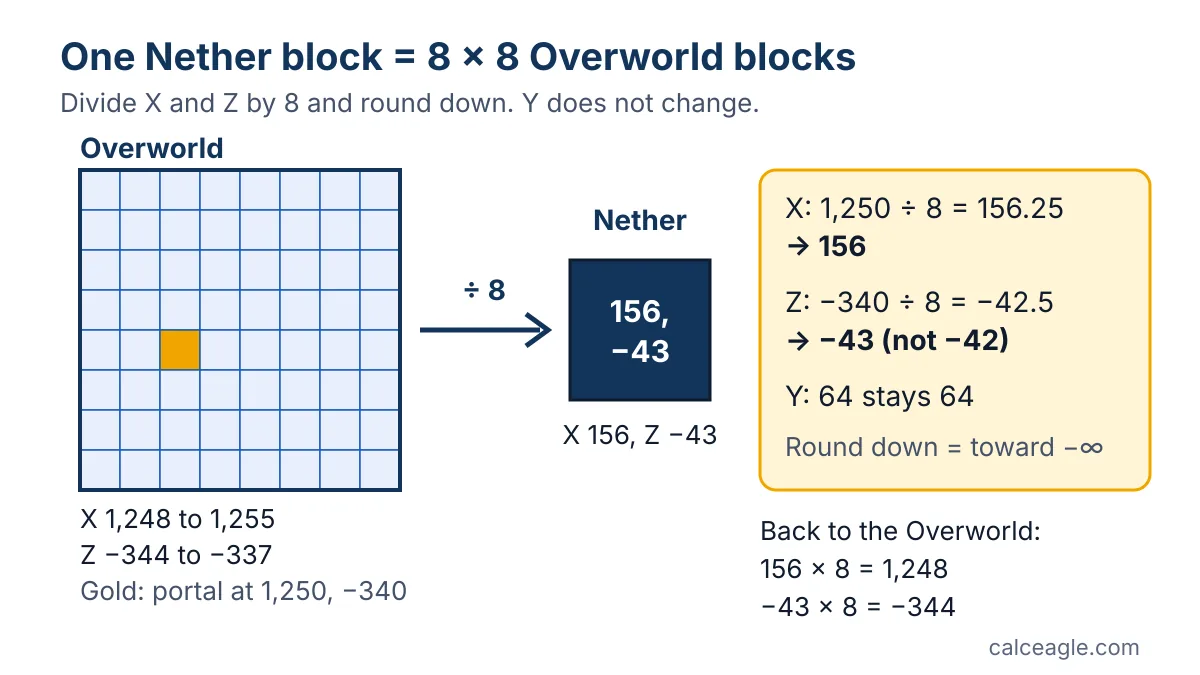
Flooring matters for negative coordinates. Dropping the decimal (truncating) moves negative values the wrong way: −340 ÷ 8 = −42.5, which floors to −43, while truncating gives −42, a different block. A block's coordinate is always the rounded-down value of any position inside it, which is why the game floors.
Example: linking a base portal to the Nether
Your Overworld portal stands at X 1,250, Y 64, Z −340.
- X: 1,250 ÷ 8 = 156.25 → round down → 156
- Z: −340 ÷ 8 = −42.5 → round down → −43
- Y: stays 64
Build the Nether side at 156, 64, −43. Any Overworld block from X 1,248 to 1,255 and Z −344 to −337 lands in that same Nether block. Going back, 156 × 8 = 1,248 and −43 × 8 = −344, right next to your base portal, which the game will find within its search range.
Planning a Nether highway
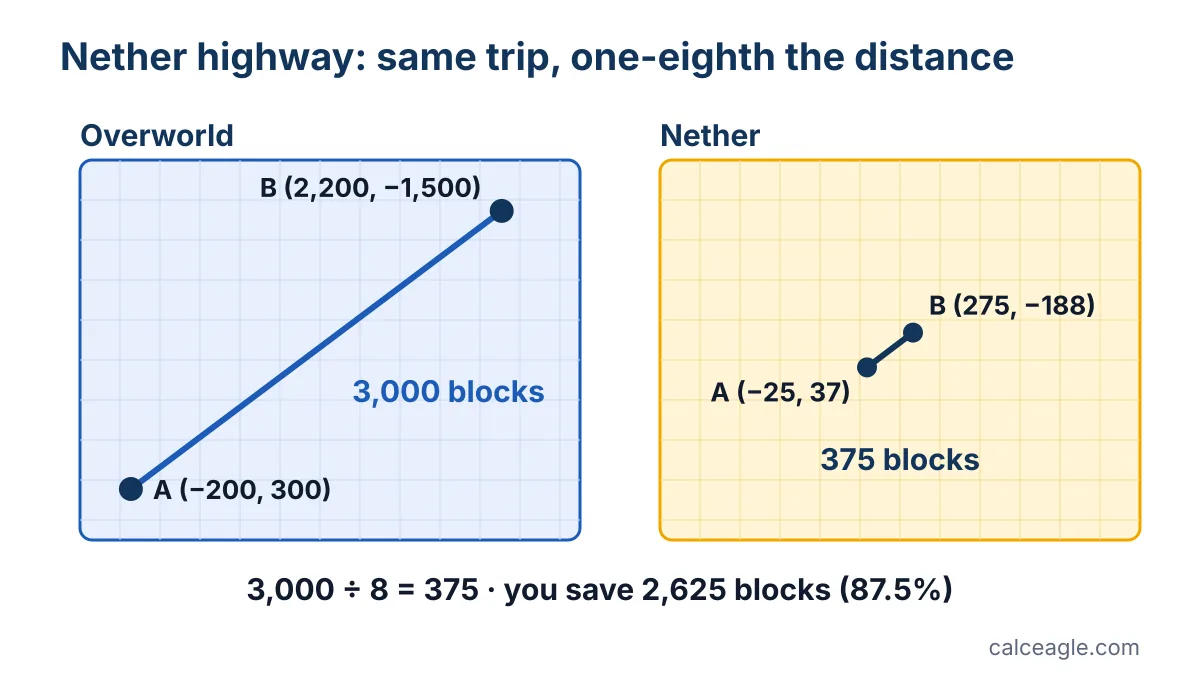
Your base is at X −200, Z 300 and a village is at X 2,200, Z −1,500.
- Nether portal for the base: −200 ÷ 8 = −25 and 300 ÷ 8 = 37.5 → (−25, 37)
- Nether portal for the village: 2,200 ÷ 8 = 275 and −1,500 ÷ 8 = −187.5 → (275, −188)
- Overworld straight-line distance: √(2,400² + 1,800²) = 3,000 blocks
- Nether distance: 3,000 ÷ 8 = 375 blocks, a saving of 2,625 blocks (87.5%)
At the wiki's sprinting speed of about 5.6 meters per second (each block is a 1-meter cube), that is roughly 8 minutes 55 seconds in the Overworld versus about 1 minute 7 seconds in the Nether, not counting the walk to each portal.
How portals link in Java and Bedrock
When you step through a portal, the game converts your position and then looks for an existing portal near that point. The search covers the full height of the dimension, and the closest portal by straight-line distance wins. Height counts, so a portal far above or below can lose to one that looks farther away on the map.
| Edition | Search when arriving in the Nether | Search when arriving in the Overworld |
|---|---|---|
| Java | 16-block radius (32 × 32 area) | 128-block radius (256 × 256 area) |
| Bedrock | 128-block radius (256 × 256 area) | 128-block radius (256 × 256 area) |
If nothing is found, the game builds a new portal. It looks for a suitable spot within 16 blocks horizontally of the target. If there isn't one, it forces a portal at the target with a small obsidian platform, keeping it between Y 70 and Y 118 in the Nether.
How to read the result
- Block coordinates are what you build at. Exact values show the division or multiplication before rounding.
- Overworld blocks that map here is the 8 × 8 footprint that shares one Nether block. Two Overworld portals inside the same footprint will lead to the same place.
- Y (block, not scaled) is simply your height. If it falls in the Nether's bedrock layers, the calculator warns you that the game will choose a different height.
- Existing-portal search radius reminds you how close an existing portal must be for the game to reuse it.
Assumptions and limitations
- Heights are from Java Edition: the Nether has bedrock at Y 0–4 and Y 123–127, and the Overworld runs from Y −64 to 320. Bedrock Edition's Nether build limit is 128 blocks instead of Java's 256.
- When converting to the Overworld, the game keeps X and Z inside the world border (−29,999,984 to 29,999,983), which only matters beyond about ±3,749,998 in the Nether. The calculator applies the same limit.
- Highway distances are horizontal straight lines. They ignore terrain, the walk to each portal, and any height difference.
- Sprinting times assume constant sprinting with no jumps, food stops or obstacles.
Common mistakes
- Truncating negative coordinates. −42.5 must become −43, not −42.
- Dividing Y by 8. Height is never scaled.
- Building the Nether portal "close enough." In Java Edition the game only looks 16 blocks around the converted point when you arrive in the Nether, so a portal 20 blocks away is ignored and the game builds a new one.
- Putting Overworld portals close together. Because 16 Nether blocks equal 128 Overworld blocks, two Overworld portals less than about 128 blocks apart can both lead to the same Nether portal in Java Edition unless each has its own Nether portal at its exact converted point.
- Assuming both editions behave the same. Bedrock searches 128 blocks in both dimensions, so mislinks there happen over longer distances.
Note: CalcEagle is an independent site. NOT AN OFFICIAL MINECRAFT PRODUCT. NOT APPROVED BY OR ASSOCIATED WITH MOJANG OR MICROSOFT. Minecraft is a trademark of Mojang and Microsoft. Game mechanics can change between versions; the figures here follow the Minecraft Wiki as of October 2026.
Frequently asked questions
How do I convert Overworld coordinates to Nether coordinates?
Divide the X and Z coordinates by 8 and round down (toward negative infinity). Keep Y the same. For example, X 1,250 and Z −340 become X 156 and Z −43.
Do you divide the Y coordinate by 8?
No. Only X and Z are scaled. Y (height) is unchanged, although the game may place a new portal at a different height if your Y is inside the Nether's bedrock layers.
Why did my portal link to the wrong portal?
The game reuses the closest existing portal within its search range: 16 blocks in the Nether and 128 blocks in the Overworld in Java Edition, and 128 blocks in both in Bedrock. Build each portal at the exact converted coordinates and keep Overworld portals far enough apart that they don't share a Nether portal.
Why is my negative Nether coordinate one lower than I expected?
The game rounds down, not toward zero. −340 ÷ 8 = −42.5, which rounds down to −43. Simply dropping the decimal would give −42, the wrong block.
Does Bedrock Edition use the same 8:1 ratio?
Yes. One block in the Nether equals eight in the Overworld in both editions. What differs is the search range for existing portals and the Nether's build height.
Sources and references
- Nether portal — Minecraft Wiki
- The Nether — Minecraft Wiki
- Coordinates — Minecraft Wiki
- Sprinting — Minecraft Wiki
- Block — Minecraft Wiki
Formulas and content last reviewed on October 13, 2026. Last updated October 13, 2026. Results are estimates for general information only. Spotted a problem? Tell us and we will check it.