Court Date Calculator
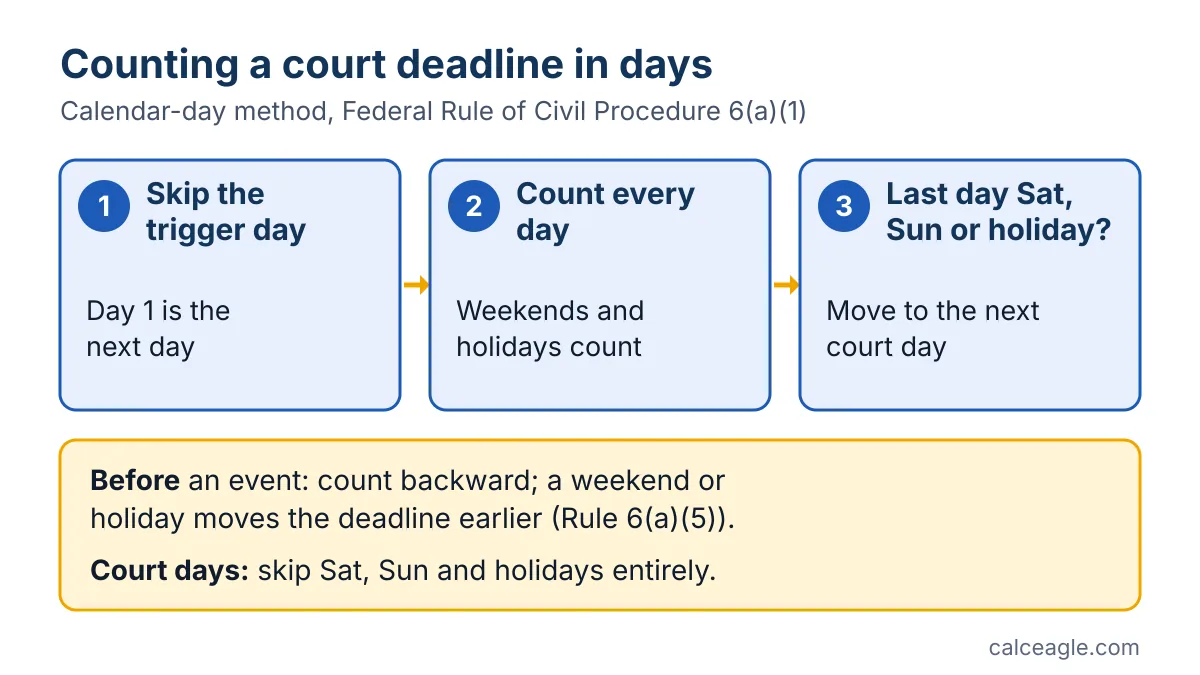
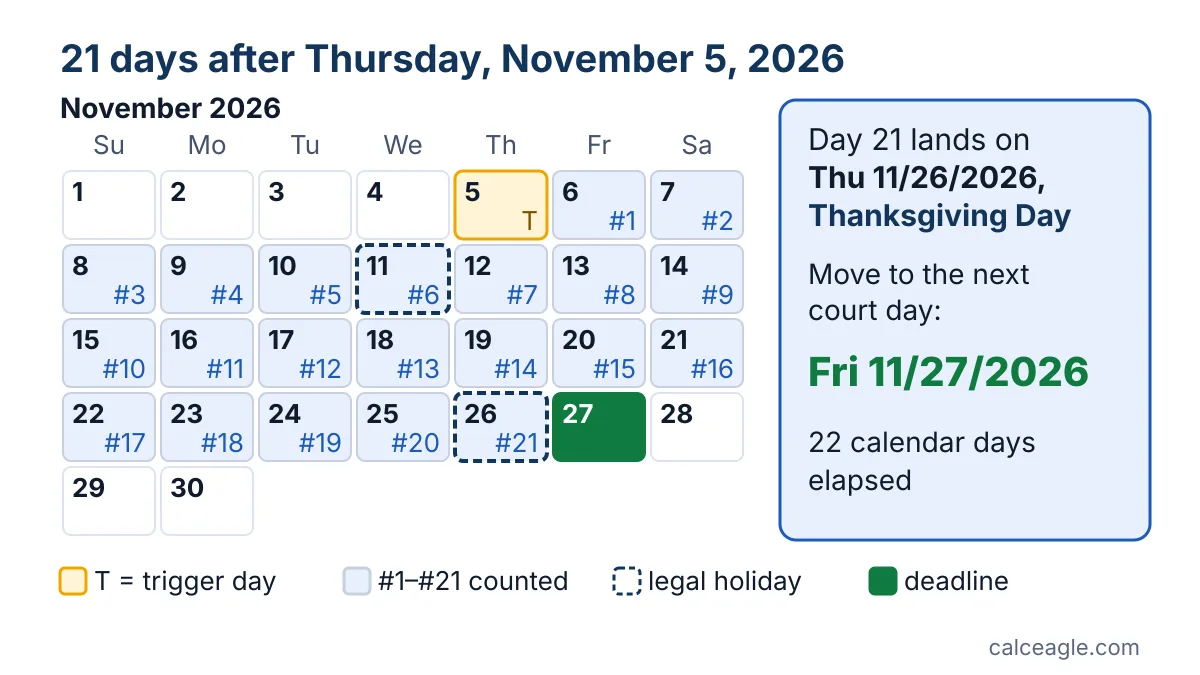
To count a court deadline under the federal rules, skip the trigger day, count every calendar day including weekends and holidays, and if the last day is a Saturday, Sunday or legal holiday, move to the next day that is not. For example, 21 days after Thursday, November 5, 2026 lands on Thanksgiving Day, so the deadline is Friday, November 27, 2026 (11/27/2026).
This court date calculator counts forward or backward in calendar days (Federal Rule of Civil Procedure 6) or court days, applies U.S. federal holidays automatically, lets you add state or court holidays, and shows every skipped day.
How to use the Court Date Calculator
- Enter the Trigger date: the event that starts the clock, such as the day you were served or the date of a hearing.
- Enter the Number of days stated in the rule, order or statute.
- Choose the Direction: After for a response period ("within 21 days after being served"), Before for a filing due a set number of days before a hearing.
- Choose the Counting method: Calendar days (FRCP 6) counts every day; Court / business days skips weekends and legal holidays.
- Leave the weekend/holiday box checked to apply Federal Rule of Civil Procedure 6(a)(1)(C). Check the FRCP 6(d) box only if 3 extra days for service apply.
- Add any extra court or state holidays, one per line (for example
11/27/2026 Day after Thanksgiving), then press Calculate.
Court date formula
Since the 2009 amendments to the Federal Rules of Civil Procedure, every period stated in days is counted the same way: skip the trigger day, count every following day, and include the last day. Only the last day can move.
| Term | Meaning |
|---|---|
| Trigger date | The event that starts the period. It is never counted (Rule 6(a)(1)(A)). |
| N | The number of days in the rule, order or statute |
| Legal holiday | A federal holiday set by statute, any day the President or Congress declares a holiday, and, for periods counted forward, a holiday declared by the state where the federal court sits (Rule 6(a)(6)) |
| Next day | Found by counting forward for periods measured after an event and backward for periods measured before an event (Rule 6(a)(5)) |
Federal holidays the calculator uses
The calculator generates the 11 legal public holidays in 5 U.S.C. 6103 for any year from 1990 to 2100. A Saturday holiday is observed the Friday before and a Sunday holiday the Monday after, matching the U.S. Office of Personnel Management (OPM) schedule.
| Holiday | 2026 (observed) | 2027 (observed) |
|---|---|---|
| New Year's Day | Thu 01/01/2026 | Fri 01/01/2027 |
| Birthday of Martin Luther King, Jr. | Mon 01/19/2026 | Mon 01/18/2027 |
| Washington's Birthday | Mon 02/16/2026 | Mon 02/15/2027 |
| Memorial Day | Mon 05/25/2026 | Mon 05/31/2027 |
| Juneteenth National Independence Day | Fri 06/19/2026 | Fri 06/18/2027 (June 19 is a Saturday) |
| Independence Day | Fri 07/03/2026 (July 4 is a Saturday) | Mon 07/05/2027 (July 4 is a Sunday) |
| Labor Day | Mon 09/07/2026 | Mon 09/06/2027 |
| Columbus Day | Mon 10/12/2026 | Mon 10/11/2027 |
| Veterans Day | Wed 11/11/2026 | Thu 11/11/2027 |
| Thanksgiving Day | Thu 11/26/2026 | Thu 11/25/2027 |
| Christmas Day | Fri 12/25/2026 | Fri 12/24/2027 (December 25 is a Saturday) |
One edge case catches people out: January 1, 2028 is a Saturday, so OPM lists New Year's Day 2028 as Friday, December 31, 2027. The calculator treats 12/31/2027 as a legal holiday.
Example: 21 days to answer a complaint
Under FRCP 12(a)(1)(A)(i), a defendant generally must serve an answer within 21 days after being served with the summons and complaint. Suppose service happened on Thursday, November 5, 2026.
- Skip the trigger day. Day 1 is Friday, November 6, 2026.
- Count 21 calendar days, including three weekends and Veterans Day (Wednesday, November 11). Day 21 is Thursday, November 26, 2026, which is Thanksgiving Day.
- Because the last day is a legal holiday, the period runs to the next day that is not a weekend or holiday: Friday, November 27, 2026 (11/27/2026).
- Calendar days elapsed: 22, one more than the 21-day period because of the holiday.
If your court also closes on Friday, November 27, add that date as an extra holiday; the weekend follows, so the deadline becomes Monday, November 30, 2026.
Counting backward. Say a paper must be filed 14 days before a hearing on Friday, January 15, 2027. Counting back 14 days lands on Friday, January 1, 2027, New Year's Day. Because the "next day" runs backward for periods measured before an event, the deadline is Thursday, December 31, 2026, not the following Monday.
Calendar days, court days and elapsed time
- Calendar days count every date on the calendar. Under the federal rules, weekends and holidays in the middle of the period count; only the last day can move. Before the 2009 amendments, the federal rule excluded weekends and holidays from periods shorter than 11 days, so older guides can give different answers.
- Court days (also called business days) skip Saturdays, Sundays and court holidays entirely. Some state rules use them. California Code of Civil Procedure § 1005(b), for example, requires motion papers to be served and filed at least 16 court days before the hearing, and adds 5 calendar days when the papers are mailed to an address in California, which mixes both methods in one rule.
- Calendar days elapsed is the plain difference between the trigger date and the deadline. It equals N unless the last day moved. With court days it is larger: 10 court days after Friday, October 9, 2026 is Monday, October 26, 2026, 17 calendar days later, because two weekends and Columbus Day are skipped.
How to read the result
- The large date is the last day to act. Under Rule 6(a)(4), unless a statute, local rule or court order says otherwise, that day ends at midnight in the court's time zone for electronic filing, and when the clerk's office is scheduled to close for other filing.
- Day N of the count shows where the raw count landed before any move.
- The holiday list shows every legal holiday inside the period, and the day-by-day count (periods up to 120 days) labels each date as counted, skipped or moved.
Assumptions and limitations
- Federal holidays follow 5 U.S.C. 6103 and OPM's observed-date rule. Juneteenth is included from 2021 on. Supported dates run from 1990 to 2100.
- One-time holidays declared by the President or Congress (Rule 6(a)(6)(B)) cannot be predicted, and state holidays count only if you add them. Under Rule 6(a)(6)(C), state holidays apply in federal court only to periods counted forward.
- Closures that make the clerk's office inaccessible (Rule 6(a)(3)) and periods stated in hours (Rule 6(a)(2)) are not handled.
- The FRCP 6(d) option follows the 2005 Committee Note: the 3 added days include weekends and holidays, and a third day that is not a court day moves forward.
Note: This calculator gives an estimate for planning, not legal advice. State courts count differently from federal courts, and local rules, court orders, the method of service (for example, FRCP 6(d) adds 3 days after certain kinds of service) and court-specific holidays all change real deadlines. Always confirm a deadline with the governing court rules or an attorney.
Common mistakes
- Counting the trigger day as day 1. The day of service or of the event is excluded; day 1 is the next day.
- Skipping weekends in a calendar-day period. Under FRCP 6, intermediate Saturdays, Sundays and holidays count.
- Using the actual holiday date instead of the observed date. Independence Day 2026 is observed on Friday, July 3, because July 4 is a Saturday.
- Moving a backward deadline forward. For a period measured before a hearing, a weekend or holiday moves the deadline earlier.
- Applying the 3-day rule to every deadline. Rule 6(d) applies only to periods that run after service, and only for certain service methods.
- Using a federal holiday list for a state court. Add your court's own holidays in the extra-holidays box.
Frequently asked questions
How do you count days for a court deadline?
Under Federal Rule of Civil Procedure 6(a)(1), exclude the day of the triggering event, count every day after it (weekends and holidays included), and include the last day. If the last day is a Saturday, Sunday or legal holiday, the period runs until the end of the next day that is not.
Do weekends count in court deadlines?
For deadlines stated in days under the federal rules, yes: intermediate Saturdays, Sundays and legal holidays are counted. Only a last day that falls on one of them moves. Rules that use court days or business days skip weekends entirely, so check which kind of day your rule uses.
What happens if a deadline is counted backward and lands on a holiday?
For periods measured before an event, Rule 6(a)(5) says the "next day" is found by counting backward. A deadline that lands on a weekend or holiday therefore moves earlier. Example: 14 days before Friday, January 15, 2027 is New Year's Day, so the deadline is Thursday, December 31, 2026.
Does service by mail add 3 days?
In federal civil cases, Rule 6(d) adds 3 days after the period would otherwise expire when a party must act within a time after being served and service was made by mail, by leaving the papers with the clerk, or by other means the party consented to. Check the FRCP 6(d) box to add them. State rules differ; California, for instance, adds 5 calendar days for in-state mail service of motion papers under CCP § 1005(b).
Which holidays are legal holidays for federal court deadlines?
Rule 6(a)(6) lists New Year's Day, Martin Luther King Jr.'s Birthday, Washington's Birthday, Memorial Day, Juneteenth National Independence Day, Independence Day, Labor Day, Columbus Day, Veterans Day, Thanksgiving Day and Christmas Day, plus any day the President or Congress declares a holiday and, for forward-counted periods, state holidays where the court sits.
Sources and references
- Rule 6. Computing and Extending Time; Time for Motion Papers (with Committee Notes) — Legal Information Institute, Cornell Law School
- 5 U.S. Code § 6103 - Holidays — Legal Information Institute, Cornell Law School
- Federal Holidays — U.S. Office of Personnel Management
- Rule 12. Defenses and Objections: When and How Presented — Legal Information Institute, Cornell Law School
- California Code of Civil Procedure § 1005 — Justia
Formulas and content last reviewed on October 13, 2026. Last updated October 13, 2026. Results are estimates for general information only. Spotted a problem? Tell us and we will check it.