Grout Calculator
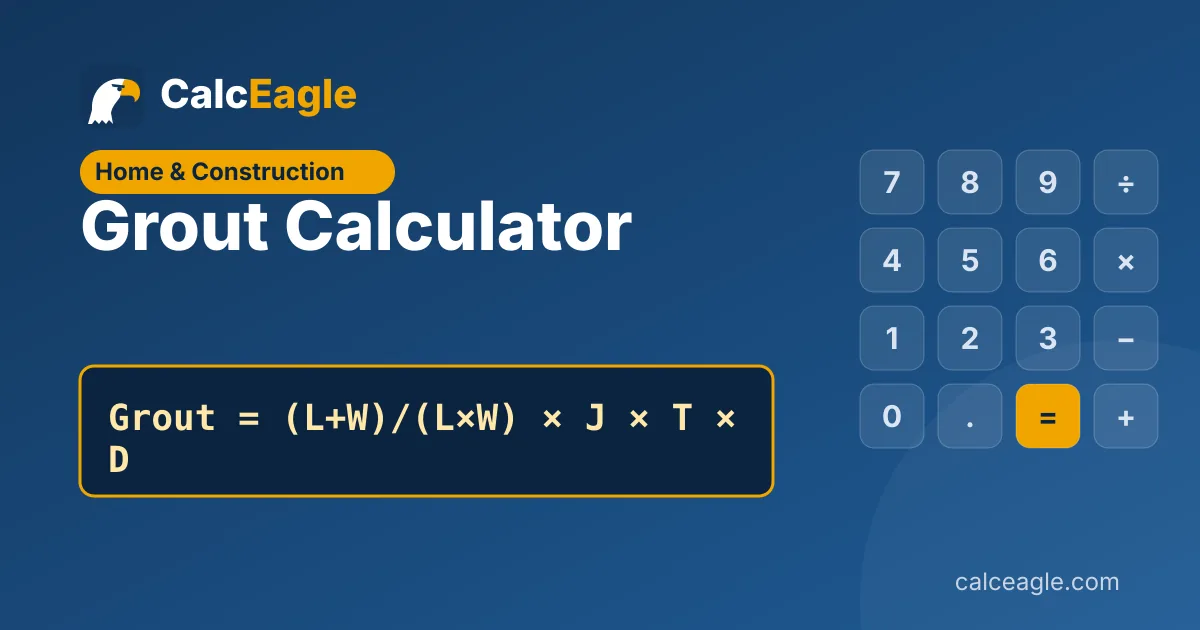
To estimate grout, work out the joint volume per square foot and convert it to weight: grout (lb per sq ft) = (L + W) ÷ (L × W) × joint width × tile thickness × density ÷ 12, with sizes in inches and density in lb/ft³. For 12 × 12 × 3/8 in tile with 3/16 in joints at 100 lb/ft³, that is about 0.098 lb per sq ft, so one 25 lb bag covers roughly 256 sq ft.
This grout calculator works with sanded and unsanded cement grouts from any brand. It rounds up to whole bags and lets you adjust the density to match the coverage chart printed on your grout's data sheet.
How to use the Grout Calculator
- Choose Inches & sq ft or Metric (mm, m²).
- Enter the Tile length, Tile width and Tile thickness. Measure an actual tile, since the size on the box can be rounded. Fractions such as 3/8 or 4 1/4 work.
- Pick the Grout joint width, from 1/16 in to 1/2 in, or choose Custom.
- Enter the Area to grout, the floor or wall area you are tiling.
- Set a Waste allowance. The default is 10%; MAPEI's online grout calculator suggests adding 5% to 10% extra.
- Enter your Bag size and, if you know it, a Grout density that matches your product (see below). Add a Price per bag for a cost estimate, then press Calculate.
Grout calculator formula
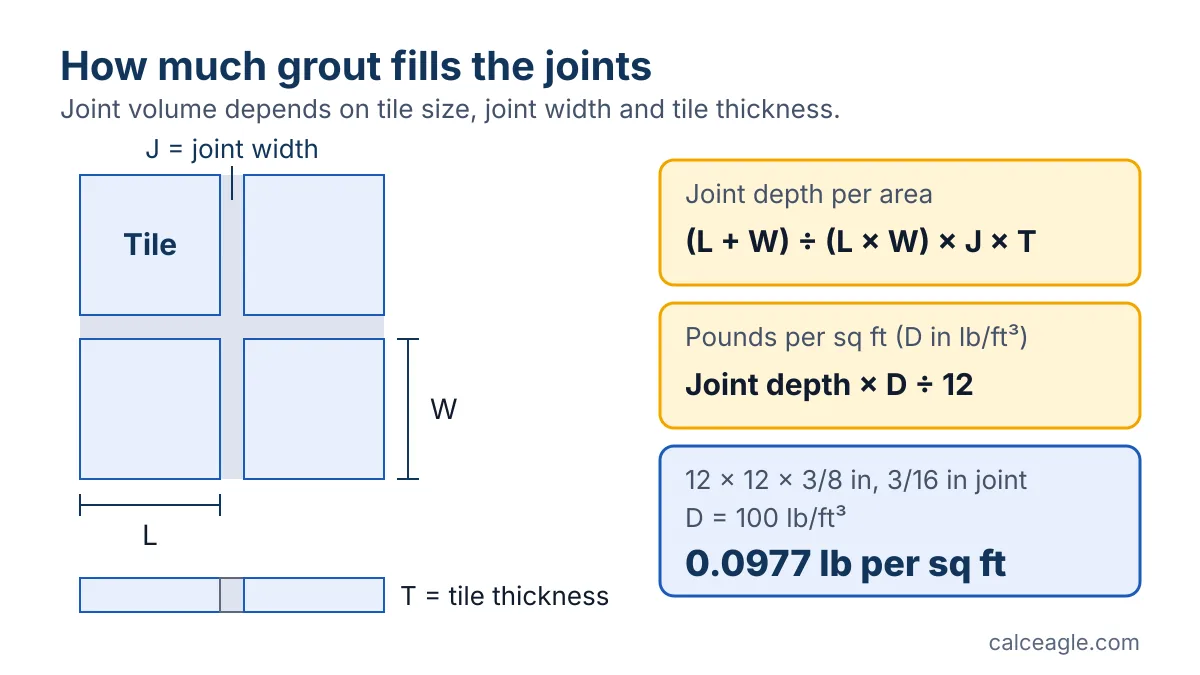
Every tile adds half its perimeter, L + W, of joint to the floor. Divide by the tile's area and you get joint length per unit of floor. Multiply by the joint width and depth to get joint volume, then by density to get weight.
| Symbol | Meaning |
|---|---|
| L, W | Tile length and width, in (mm in metric) |
| T | Tile thickness, which sets the joint depth, in (mm) |
| J | Joint width, in (mm) |
| D | Grout density, lb/ft³ (kg/m³) |
| 12 | 144 sq in per sq ft ÷ 1,728 cu in per cu ft |
About density. D is the weight of grout powder needed to fill a given volume of joint. MAPEI's data sheet for Keracolor GG grout gives the consumption formula kg/m² = (A + B) ÷ (A × B) × C × D × 1.6, with all sizes in mm. That 1.6 factor equals 1,600 kg/m³, or about 100 lb/ft³, which is the calculator's default. It is not the same as the density of the mixed grout, which the same data sheet lists separately as 2,000 kg/m³, so use the coverage-based value.
Example: 300 sq ft of 12 × 12 tile with 3/16 in joints
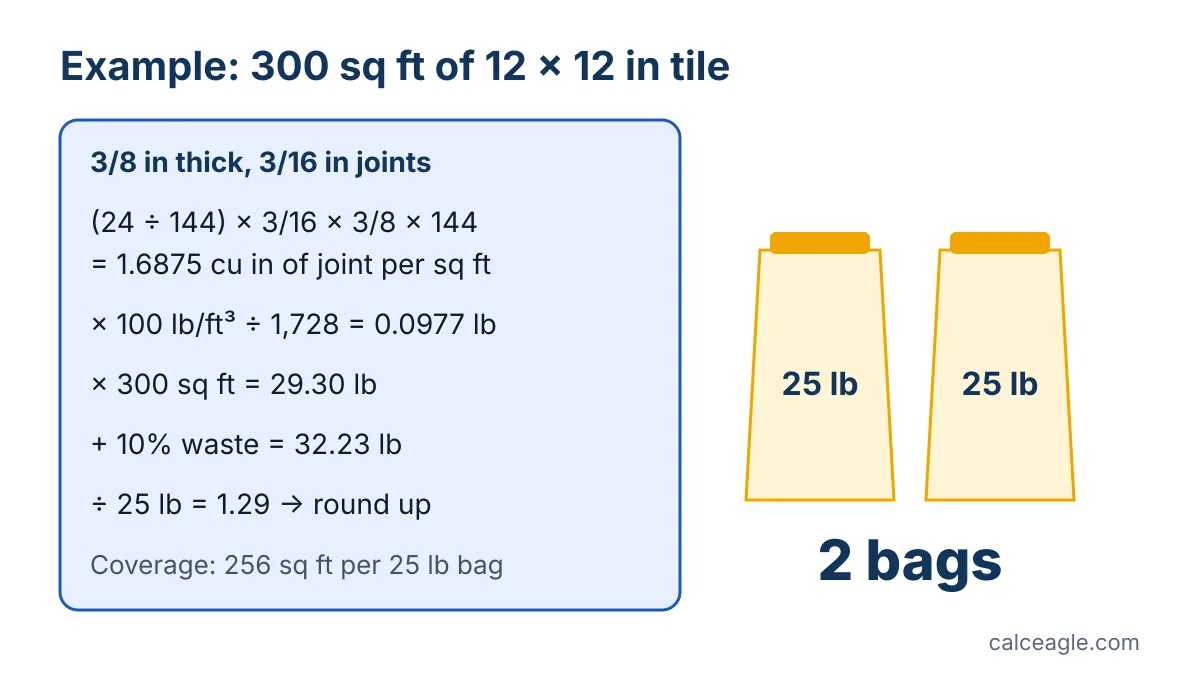
A kitchen and family-room floor has 300 sq ft of 12 × 12 × 3/8 in porcelain tile with 3/16 in joints. The grout comes in 25 lb bags, and the plan adds 10% for waste.
- Joint factor: (12 + 12) ÷ (12 × 12) = 0.1667 per in.
- Joint depth per area: 0.1667 × 3/16 × 3/8 = 0.01172 in, or 1.6875 cu in of joint per sq ft.
- Weight per sq ft: 1.6875 × 100 ÷ 1,728 = 0.0977 lb.
- Before waste: 0.0977 × 300 = 29.30 lb.
- With 10% waste: 29.30 × 1.10 = 32.23 lb (14.62 kg).
- Bags: 32.23 ÷ 25 = 1.29, rounded up to 2 bags.
One 25 lb bag covers 25 ÷ 0.0977 = 256 sq ft before waste. MAPEI's Keracolor S chart lists 253 sq ft for the same tile and joint, about 1% less.
Using a manufacturer's coverage chart
Grout makers publish coverage charts on their technical data sheets, and MAPEI also offers its own Tile Grouts Calculator. CalcEagle is independent and not affiliated with MAPEI or any other grout maker. To read a chart:
- Find the row for your tile size and thickness.
- Find the column for your joint width. The cell is the area one bag covers.
- Divide your area by that coverage, add waste, and round up to whole bags.
Here is how this calculator, at its default 100 lb/ft³, compares with MAPEI's Keracolor S chart (sq ft per 25 lb bag):
| Tile (in) | Joint | MAPEI chart | This calculator |
|---|---|---|---|
| 24 × 24 × 3/8 | 1/8 in | 768 | 768 |
| 12 × 12 × 3/8 | 1/8 in | 383 | 384 |
| 12 × 12 × 3/8 | 3/16 in | 253 | 256 |
| 6 × 6 × 1/4 | 1/8 in | 285 | 288 |
| 2 × 2 × 1/4 | 1/8 in | 93 | 96 |
| 1 × 1 × 1/4 | 3/8 in | 14 | 16 |
Charts from other brands can differ. Custom Building Products' Polyblend Plus chart lists 348 sq ft per 25 lb bag for 12 × 12 × 3/8 in tile with 1/8 in joints, about 9% less than MAPEI's 383. To match a specific chart, scale the density: 100 × (calculator coverage ÷ chart coverage). For that Polyblend Plus cell, 100 × 384 ÷ 348 ≈ 110 lb/ft³.
How to read the result
- Grout to buy is the number of bags, rounded up, including your waste allowance.
- Grout per sq ft and Coverage per bag let you check the answer against your product's chart before you buy.
- Joint width and tile thickness scale the answer directly. Doubling the joint width doubles the grout, and a 1/2 in thick tile needs one-third more grout than a 3/8 in tile of the same size.
Assumptions and limitations
- Joints are filled to the full tile thickness, which is also how the MAPEI chart figures compare. MAPEI's instructions call for clearing about two-thirds of the tile depth for grout, so real use is often a little lower.
- All tiles are the same rectangular size. Layout pattern does not change the result, because each tile contributes the same length of joint. Hexagons, mixed-size patterns and irregular stone are not modeled.
- Small mosaics with wide joints use more grout than the formula predicts in MAPEI's chart (for example, 14 vs. 16 sq ft per bag for 1 × 1 in tile with 3/8 in joints), so add extra waste for mosaics.
- The default density comes from MAPEI's cement grout formula. Other brands' charts imply roughly 5% to 10% more grout for the same joints, and epoxy or other non-cement grouts need their own chart.
- Results are estimates. Confirm with the coverage chart on your grout's data sheet.
Common mistakes
- Using the wrong grout type for the joint. MAPEI says its Keracolor S sanded grout should not be used in joints narrower than 1/8 in, and Custom notes that non-sanded grout may suit joints up to 1/8 in. Custom also recommends testing sanded grout on a small area, because it can scratch some tile.
- Leaving out tile thickness. Thicker tile means deeper joints and more grout.
- Grouting with uneven joints. If spacers drift, measure the actual joint width before you buy.
- Mixing bags separately. If you use more than one bag at a time, MAPEI and Custom both say to dry-blend the powder first so the color stays even.
Planning more of the project? The Brick Calculator counts brick and mortar for a wall, and the Drop Ceiling Calculator estimates a suspended ceiling grid. For a quick markup or tax figure, use the Percentage Calculator.
Frequently asked questions
How many square feet does a 25 lb bag of grout cover?
It depends on the tile size, thickness and joint width. MAPEI's Keracolor S chart ranges from 7 sq ft (1 × 1 in mosaic, 5/8 in joints) to 768 sq ft (24 × 24 in tile, 1/8 in joints). For 12 × 12 × 3/8 in tile it lists 383 sq ft at 1/8 in, 253 sq ft at 3/16 in and 191 sq ft at 1/4 in joints.
Is this the MAPEI grout calculator?
No. CalcEagle is independent and not affiliated with MAPEI. This calculator uses a volume-times-density method like the one in MAPEI's data sheets, and you can compare its answer with MAPEI's own Tile Grouts Calculator or the chart for your product.
How much grout do I need for 100 sq ft?
For 12 × 12 × 3/8 in tile with 3/16 in joints: 0.0977 lb × 100 = 9.77 lb, or 10.74 lb with 10% waste. That is one 25 lb bag or two 10 lb bags. Smaller tiles and wider joints need more.
Should I use sanded or unsanded grout?
Sanded grout is made for wider joints: MAPEI's Keracolor S covers 1/8 to 5/8 in and should not be used below 1/8 in. Custom Building Products says non-sanded grout may be appropriate for joints up to 1/8 in. Follow the tile maker's advice too, since sanded grout can scratch some tile.
Can I use this calculator for epoxy grout?
The formula still applies, but the default density was derived from cement grout charts. For epoxy or other non-cement grouts, use the manufacturer's coverage chart or set the density so the calculator matches it.
Sources and references
- Keracolor S Sanded Grout: Technical Data Sheet — MAPEI (via BuildSite)
- Tile Grouts Calculator — MAPEI
- Keracolor GG Technical Data Sheet (consumption formula) — MAPEI (via ArchiExpo)
- Polyblend Plus Sanded and Non-Sanded Grout: Technical Data Sheet — Custom Building Products
- AccuColor Premium Sanded Grout: Product Data Sheet — TEC (H.B. Fuller)
Formulas and content last reviewed on October 13, 2026. Last updated October 13, 2026. Results are estimates for general information only. Spotted a problem? Tell us and we will check it.