Geometric Mean Calculator
The geometric mean of n positive numbers is the n-th root of their product: GM = (x₁ × x₂ × … × xₙ)^(1/n). For 2, 8 and 32, the product is 512 and the cube root is 8.
For percent returns, average the growth factors instead of the percents: returns of +10%, −5% and +12% multiply to 1.1704, so the geometric average is 5.38% per year, not the 5.67% a simple average suggests.
How to use the Geometric Mean Calculator
- Choose what you want to average: A list of numbers or Growth rates / returns (%).
- For a list, type or paste your values into Numbers (all greater than 0). Separate them with commas, spaces or line breaks; a column copied from a spreadsheet works. Leave out thousands separators, so type 1250 rather than 1,250.
- For growth rates, enter one percent change per period in Percent change for each period: 10 means a 10% gain and -5 means a 5% loss. You can also enter a Starting value (optional) to see what it grows to.
- Press Calculate. The result shows the geometric mean (or average growth rate), the arithmetic and harmonic means for comparison, the number of values and the worked steps. It updates as you edit.
Geometric mean formula
The geometric mean is the n-th root of the product of n positive numbers. For growth rates, each percent is first turned into a growth factor (1 + r):
| Symbol | Meaning |
|---|---|
| x₁ … xₙ | The positive values you are averaging |
| n | How many values there are |
| r₁ … rₙ | Percent change in each period, written as a decimal (10% = 0.10, −5% = −0.05) |
| GM | The geometric mean |
The two versions of the first formula give the same answer. The calculator uses the logarithm version: it adds the natural logs of the values, divides by n and raises e to that power. Multiplying hundreds of large numbers directly can exceed the biggest number a computer's standard floating-point format can store, while adding their logarithms never does, so long lists and huge values still work.
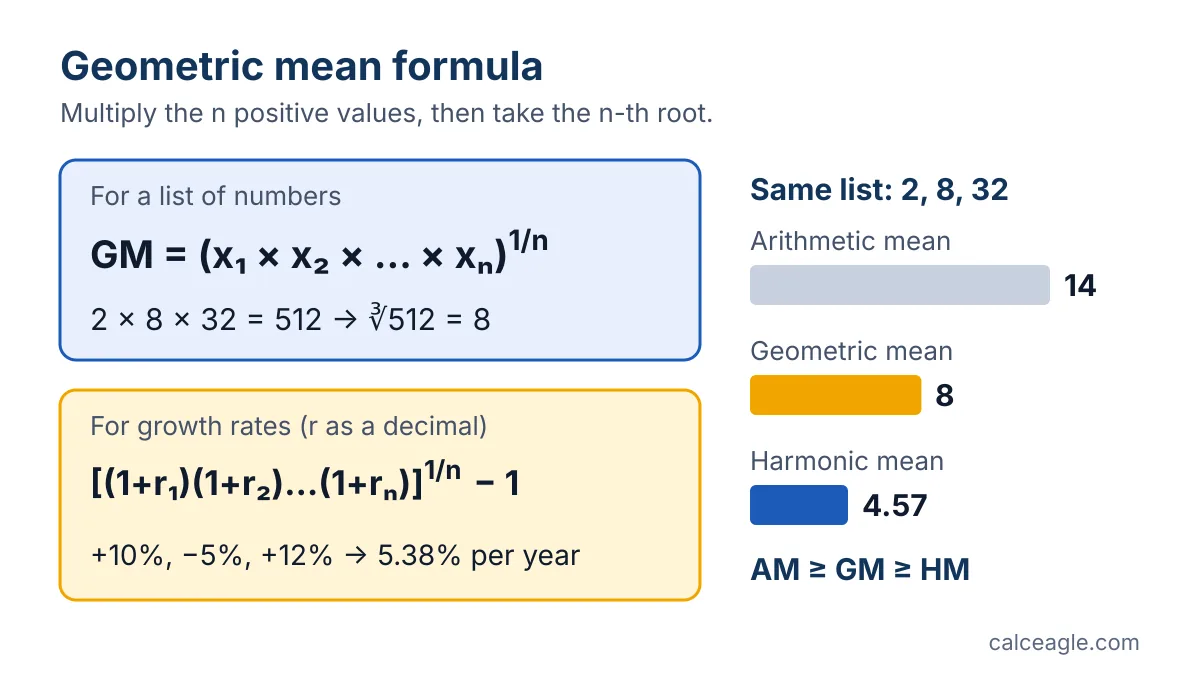
Example: average annual return on a $10,000 investment
Suppose $10,000 earns +10% in year one, loses 5% in year two and earns +12% in year three.
- Growth factors: 1.10, 0.95 and 1.12.
- Multiply them: 1.10 × 0.95 × 1.12 = 1.1704. The investment ends at $10,000 × 1.1704 = $11,704.
- Take the cube root (n = 3): 1.1704^(1/3) = 1.053848.
- Subtract 1: the average annual return is 5.38%.
Check: $10,000 × 1.053848³ = $11,704, the same ending balance. The simple (arithmetic) average of the three returns is (10 − 5 + 12) ÷ 3 = 5.67%, but compounding 5.67% for three years would give about $11,798, roughly $94 more than the investment actually earned. That gap is why the geometric mean is the right average for anything that compounds.
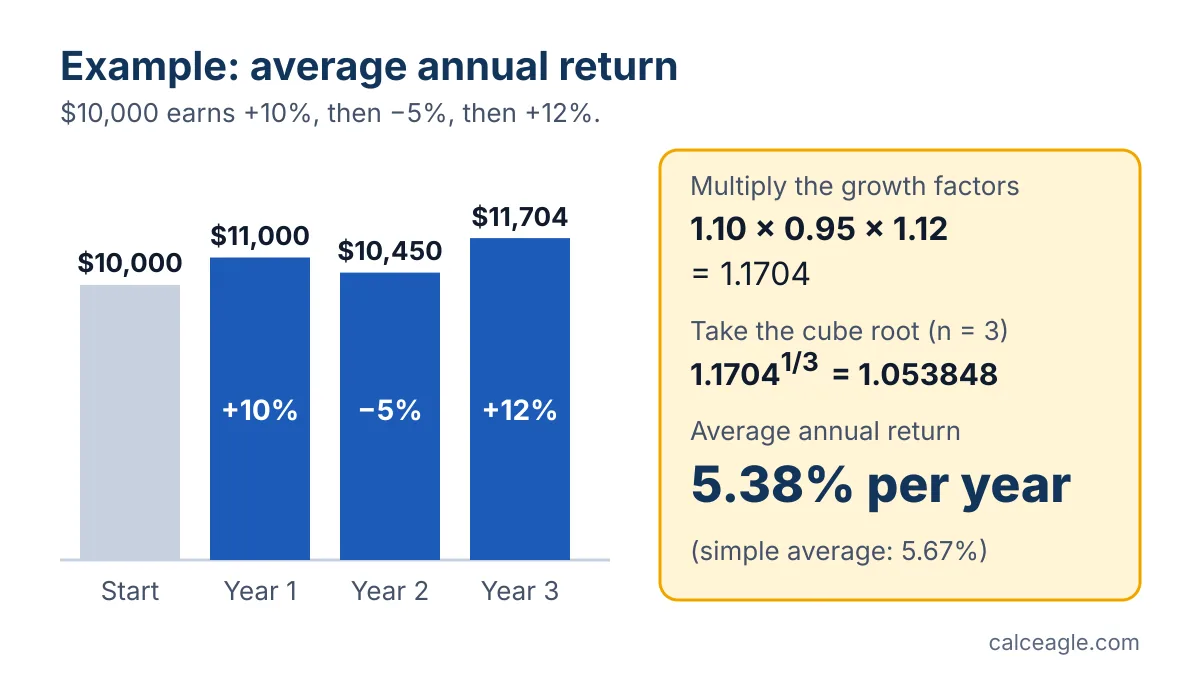
A plain list works the same way. For 2, 8 and 32 the product is 512, and the cube root of 512 is 8. The arithmetic mean of the same numbers is 14 and the harmonic mean is about 4.57.
Geometric, arithmetic or harmonic mean?
For any list of positive numbers, the arithmetic mean is at least as large as the geometric mean, which is at least as large as the harmonic mean. They are equal only when every value is the same. Which one to use depends on how the numbers combine:
| Use this mean | When the values… | Example |
|---|---|---|
| Arithmetic | add up to a meaningful total | Average test score, average height |
| Geometric | multiply, compound or are ratios | Average yearly return, average growth factor, values spread across several orders of magnitude |
| Harmonic | are rates over a fixed amount | Driving 60 mph one way and 40 mph back averages 48 mph |
Geometric means are also used in official statistics. Effective with January 1999 data, the U.S. Bureau of Labor Statistics began using a geometric mean formula for indexes that make up about 61% of the Consumer Price Index, a change its research suggested would lower measured inflation by about 0.2 percentage point a year.
Why zero and negative numbers don't work
The standard geometric mean is defined only for numbers greater than zero:
- Zero: any product that includes 0 is 0, so the geometric mean would be 0 no matter what the other values are. The natural log of 0 is also undefined.
- Negative numbers: the product can be negative, and an even root of a negative number (such as a square root) is not a real number. Even when two negatives multiply to a positive, the answer hides the fact that the values were negative.
- Losses of 100% or more: in growth mode, a −100% return turns the growth factor into 0, and anything below −100% makes it negative. Once an investment is wiped out, no average growth rate can describe it, so the calculator asks you to correct those entries.
Negative returns are fine, because the calculator averages the growth factors, not the percents. A −5% year becomes a factor of 0.95, which is positive. If your raw data genuinely contains zeros or negative values, the geometric mean is not the right summary; consider the arithmetic mean or the median instead.
How to read the result
- Geometric mean: the single value that, multiplied by itself n times, gives the same product as your list.
- Average growth rate: the steady rate per period that turns the starting value into the same ending value. It is the compound annual growth rate when each period is one year.
- Cumulative growth: the total change over all periods, (1 + r₁)(1 + r₂)…(1 + rₙ) − 1. In the example it is +17.04%.
- Comparison means: a large gap between the arithmetic and geometric means signals that your values vary a lot.
Assumptions and limitations
- Each value counts equally (an unweighted mean). Growth periods should all be the same length, such as one year each.
- Results are rounded for display, usually to 4–6 decimal places. Very large or small results are shown in scientific notation.
- The calculator accepts up to 10,000 values.
- An average of past returns describes what happened; it does not predict future returns.
Note: This calculator does math on the numbers you enter. It is not investment, tax or financial advice, and it ignores fees, taxes, deposits and withdrawals unless they are already reflected in your returns.
Common mistakes
- Averaging percent returns arithmetically. Gains and losses compound, so +50% followed by −50% leaves you with 75% of your money, a geometric average of about −13.4% per period, not 0%.
- Mixing up the two input styles. In list mode enter growth factors (1.10, 0.95, 1.12); in growth mode enter percents (10, -5, 12). Entering 10, -5, 12 in list mode is rejected because of the negative value.
- Using thousands separators. Commas separate values, so 1,250 would be read as two numbers.
- Mixing period lengths. Monthly and yearly returns cannot be averaged together without converting them first.
Working with simple percent changes? Use the Percentage Calculator. For a quantity that shrinks by a steady percentage, the Exponential Decay Calculator applies the same compounding idea in reverse.
Frequently asked questions
How do you calculate the geometric mean?
Multiply all n values together, then take the n-th root of the product. For 4 and 9: 4 × 9 = 36, and √36 = 6. With many values, it is easier to average their logarithms and raise e to that average, which gives the same answer.
When should I use the geometric mean instead of the regular average?
Use it when values multiply or compound: investment returns, growth rates, ratios and index numbers. Use the ordinary (arithmetic) mean when values add up to a meaningful total, such as test scores.
Can the geometric mean be zero or negative?
Not for the standard geometric mean. Every value must be greater than 0: a single zero makes the product 0, and negative values can make the root undefined. For percent changes such as −5%, convert to growth factors (0.95) first; the calculator's growth-rate mode does this for you.
How do I find the average annual return using the geometric mean?
Convert each yearly return to a factor (1 + r), multiply the factors, take the n-th root and subtract 1. For +10%, −5% and +12%: 1.10 × 0.95 × 1.12 = 1.1704, 1.1704^(1/3) = 1.0538, so the average return is about 5.38% per year.
Why is the geometric mean smaller than the arithmetic mean?
For positive numbers, the arithmetic mean is always greater than or equal to the geometric mean. They are equal only when all values are the same; the more the values vary, the bigger the gap. For 2, 8 and 32, the arithmetic mean is 14 but the geometric mean is 8.
Sources and references
- 2.5 Geometric Mean (Introductory Business Statistics) — OpenStax, Rice University
- New CPI estimator expected to lower inflation rate by 0.2 percent — U.S. Bureau of Labor Statistics, The Economics Daily
- Geometric Mean — Wolfram MathWorld
Formulas and content last reviewed on October 13, 2026. Last updated October 13, 2026. Results are estimates for general information only. Spotted a problem? Tell us and we will check it.