Out-the-Door Price Calculator
Your out-the-door price is the total cost of buying a vehicle once sales tax and every fee are added: price + add-ons − rebate + sales tax + fees. Your trade-in and down payment then reduce what you owe at signing or finance.
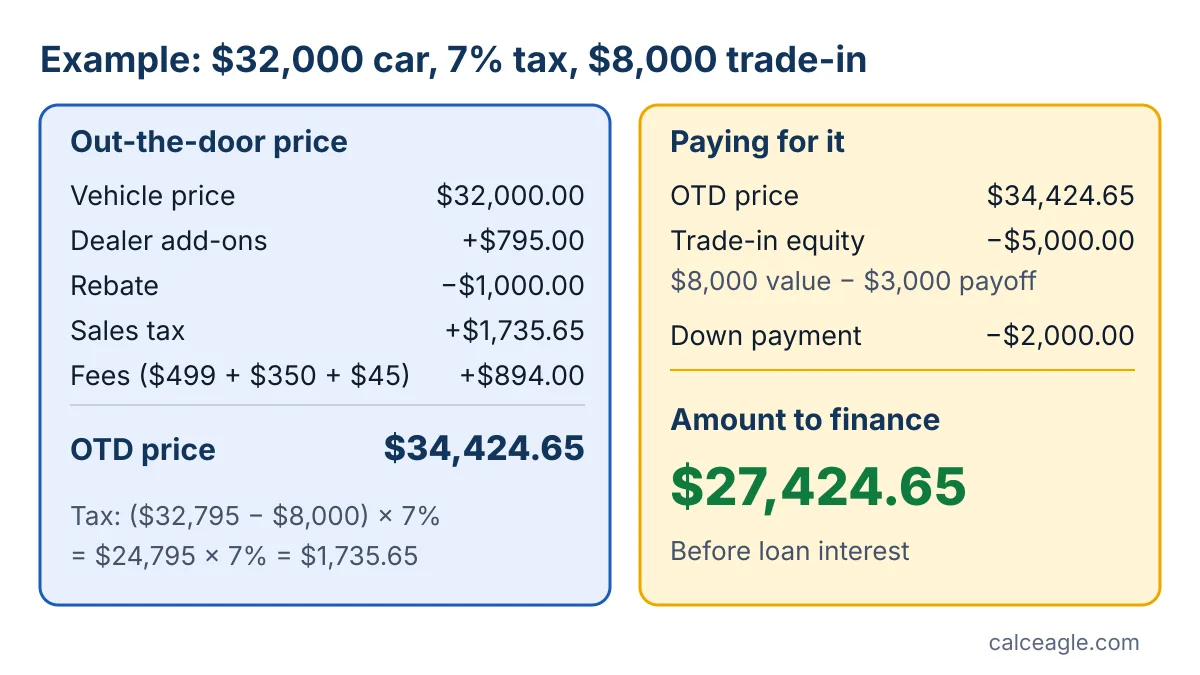
In the default example ($32,000 price, $795 add-ons, $1,000 rebate, an $8,000 trade-in with $3,000 still owed, 7% sales tax and $894 in fees), the out-the-door price is $34,424.65 and the amount to finance after $2,000 down is $27,424.65.
How to use the out-the-door price calculator
- Enter the Vehicle price (negotiated): the selling price you agreed on, before tax and fees.
- Enter any Dealer add-ons, such as accessories or packages the dealer adds. They are taxed with the car.
- Enter a Manufacturer rebate, then choose whether your state charges Sales tax on a rebate before or after it is subtracted.
- Enter the Trade-in value the dealer offers and the Loan payoff on trade-in you still owe. Check the box if your state subtracts the trade-in value before charging sales tax.
- Enter the Sales tax rate (state + local) for the place where the car will be registered.
- Enter the Doc fee, Title & registration and Other fees from the dealer's quote, and check the box if your state taxes the doc fee.
- Add a Down payment if you plan to make one, then press Calculate. You get the out-the-door price, a line-by-line breakdown and the amount left to finance.
Out-the-door price formula
| Term | Meaning |
|---|---|
| Taxed price | Price + add-ons, minus the rebate only if your state taxes the price after the rebate, plus the doc fee if your state taxes it |
| Trade-in credit | The full trade-in value, in states that allow a credit; otherwise $0 |
| Tax rate | Combined state and local rate, as a decimal (7% = 0.07) |
| Trade-in equity | What the trade-in is worth minus what you owe on it; negative means negative equity |
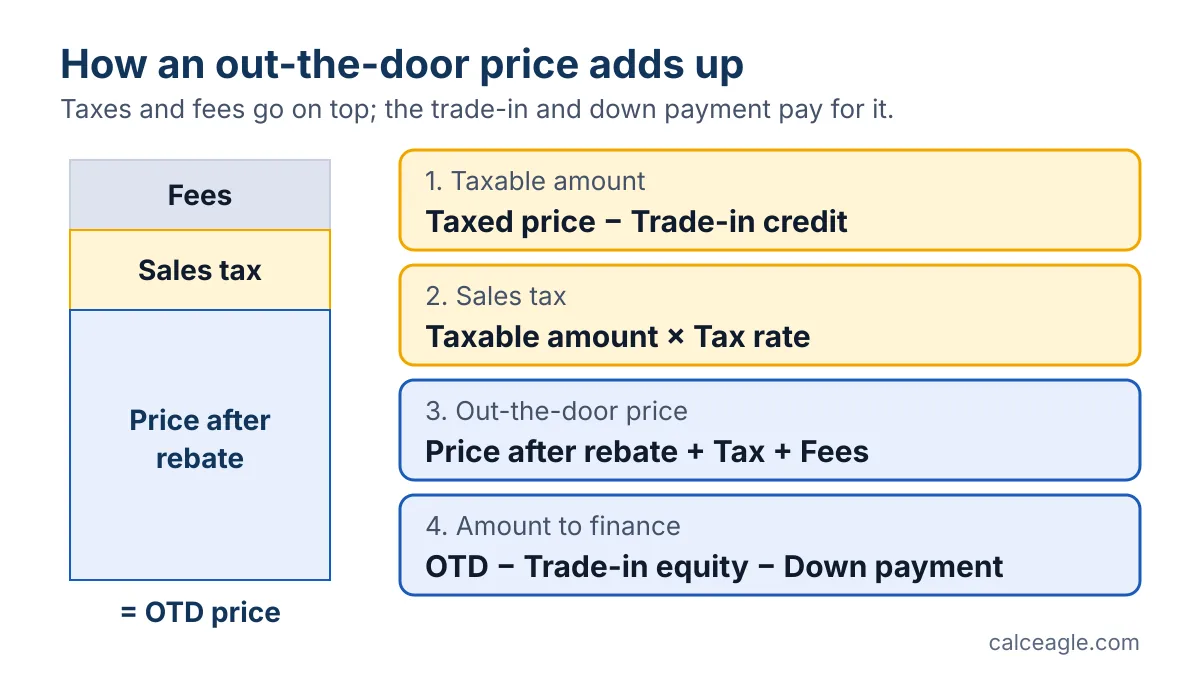
The out-the-door (OTD) price is what the vehicle deal costs before you decide how to pay. Your trade-in equity and down payment are ways of paying it, so they come off afterward. The trade-in tax credit uses the trade-in value, not your equity. Sales tax is rounded to the nearest cent, as it would be on a bill of sale.
Example: a $32,000 car with a trade-in
You negotiate a $32,000 price and accept $795 in dealer add-ons. A $1,000 manufacturer rebate applies, and your state taxes the price before the rebate. The dealer offers $8,000 for your trade-in, which still has a $3,000 loan, and your state gives a trade-in credit. Your combined tax rate is 7%. The quote lists a $499 doc fee, $350 for title and registration and a $45 tire fee. You'll put $2,000 down.
- Selling price: $32,000 + $795 = $32,795.
- Taxable amount: $32,795 − $8,000 trade-in credit = $24,795.
- Sales tax: $24,795 × 0.07 = $1,735.65.
- Fees: $499 + $350 + $45 = $894.00.
- Out-the-door price: $32,795 − $1,000 + $1,735.65 + $894 = $34,424.65.
- Trade-in equity: $8,000 − $3,000 = $5,000.
- Amount to finance: $34,424.65 − $5,000 − $2,000 = $27,424.65.
The same deal under other state rules:
| State rule | Taxable amount | Sales tax | OTD price | Amount to finance |
|---|---|---|---|---|
| Rebate taxed, trade-in credit (example) | $24,795.00 | $1,735.65 | $34,424.65 | $27,424.65 |
| Rebate not taxed, trade-in credit | $23,795.00 | $1,665.65 | $34,354.65 | $27,354.65 |
| Rebate taxed, no trade-in credit | $32,795.00 | $2,295.65 | $34,984.65 | $27,984.65 |
| Rebate not taxed, no trade-in credit | $31,795.00 | $2,225.65 | $34,914.65 | $27,914.65 |
The trade-in credit is worth $8,000 × 7% = $560 here, which is why it matters which state you register in.
How state rules change the math
Every state sets its own rules for vehicle sales tax, so use the checkboxes and the rebate option to match yours. A few verified examples show how much they differ:
- Washington charges retail sales tax on the price after the value of a like-kind trade-in is deducted, and that value cannot be reduced by payoffs or other encumbrances (Washington Department of Revenue). Check the trade-in box.
- Virginia's motor vehicle sales and use tax uses a sale price with no deduction for trade-ins, and it excludes manufacturer rebates or incentives applied to the purchase (Code of Virginia § 58.1-2401). Uncheck the trade-in box and choose Tax price after rebate.
- Idaho subtracts the trade-in allowance from the taxable price, but a manufacturer rebate lowers it only when the rebate is paid directly to the dealer and subtracted from the price. Document fees are part of the taxable sales price, and a down payment does not reduce it (Idaho State Tax Commission).
- New York limits the fee a dealer may charge for handling your title and registration paperwork to $175, separate from the DMV's own fees (New York DMV, Part 78).
Rules change, so confirm with your state's revenue department or DMV before you sign.
How to read the result
- Out-the-door price is the full cost of the vehicle deal. Compare dealers on this number, not on the monthly payment. The FTC suggests getting an out-the-door price in writing before you visit the lot (FTC).
- Taxable amount shows what your sales tax was charged on, after any rebate or trade-in rules.
- Amount to finance is what you would borrow before interest. If your trade-in is worth less than you owe, the shortfall is added here. The FTC notes that negative equity can increase the amount you borrow and the length of your financing.
- Owed back to you appears when your trade-in equity is larger than the out-the-door price.
Assumptions and limitations
- Dealer add-ons are taxed with the car. Title, registration and the other fees you enter are not taxed.
- One combined tax rate applies to the whole taxable amount. Some states, such as Virginia, use a separate motor vehicle tax with its own rules, so your bill of sale may differ.
- Loan interest, insurance, extended warranties and other finance-office products are not included unless you add them.
- Leases are not covered.
Common mistakes
- Negotiating the payment instead of the price. A lower payment can hide a longer loan or extra products.
- Treating add-ons as required. The FTC notes that add-ons are not free and that you can say no to them and ask their price.
- Using the state rate only. County or city taxes can add to the state rate, so use the combined rate. To check a single tax line on a quote, the Percentage Calculator finds any percent of an amount.
- Ignoring negative equity. Rolling an old loan balance into the new one raises the amount you finance.
- Assuming one state's rules apply everywhere. If you buy in one state and register in another, ask the dealer or your DMV which state's tax and rules apply.
Note: This calculator gives estimates for U.S. vehicle purchases for education only. It is not tax, legal or financial advice. State and local rules on rebates, trade-in credits, doc fees and rates vary and change, so check the dealer's itemized buyer's order and your state's DMV or revenue department.
Frequently asked questions
What does an out-the-door price include?
The negotiated vehicle price, dealer add-ons, sales tax and all fees, such as the doc fee, title and registration, minus any rebate. Your trade-in equity and down payment are then applied to that total.
Does a trade-in lower the sales tax on a car?
In some states, yes, but not everywhere. Washington taxes the price after the trade-in value is deducted, while Virginia's motor vehicle sales and use tax allows no deduction for trade-ins. Use the trade-in checkbox to match your state.
Is sales tax charged before or after a manufacturer rebate?
It depends on the state. Virginia excludes manufacturer rebates from the taxable sale price. Idaho lowers the taxable price only when the rebate is paid directly to the dealer and subtracted from the price. If you are unsure, choose Tax price before rebate for the higher estimate.
Is the dealer doc fee capped or taxed?
Some states regulate it. New York limits the dealer's fee for title and registration paperwork to $175, and Idaho counts document fees as part of the taxable sales price. Other states have different rules, so ask for the doc fee in writing.
What happens if I owe more on my trade-in than it is worth?
That shortfall is negative equity. It does not reduce the price; it is usually added to your new loan, which raises the amount you finance. The calculator adds it to Amount to finance automatically.
Sources and references
- Buying a New Car — Federal Trade Commission, Consumer Advice
- Trade-ins (Auto dealers industry guide) — Washington State Department of Revenue
- § 58.1-2401. Definitions (Motor Vehicle Sales and Use Tax) — Code of Virginia, Virginia General Assembly
- Sales Price – Motor Vehicles – Dealers — Idaho State Tax Commission
- Part 78: Motor Vehicle Dealers and Transporters (Section 78.19) — New York State Department of Motor Vehicles
Formulas and content last reviewed on October 13, 2026. Last updated October 13, 2026. Results are estimates for general information only. Spotted a problem? Tell us and we will check it.