DRIP Calculator
A DRIP (dividend reinvestment plan) uses each cash dividend to buy more shares, so the next dividend is paid on a larger share count. This calculator projects that compounding year by year from your yield, dividend growth and price growth assumptions, and compares it with taking the dividends as cash.
In the default example ($10,000 at $50 a share, a 4% yield paid quarterly, 5% dividend growth, 4% price growth and $1,200 added each year), reinvesting grows the account to $39,902.27 after 10 years, versus $36,801.63 when dividends are taken as cash.
How to use the DRIP calculator
- Enter your Initial investment and the current Share price. The calculator divides one by the other to get your starting shares, and fractional shares are fine.
- Enter the Dividend yield: the annual dividend per share divided by today's share price, as a percent (type 4 for 4%).
- Set Dividend growth (how fast the dividend per share rises each year) and Price growth (how fast the share price changes each year, not counting dividends). Use negative numbers for cuts or declines.
- Choose the Dividend payment frequency that matches the stock or fund: monthly, quarterly, semiannual or annual.
- Enter Years to hold (1 to 60) and a Dividend tax rate. Use 0 for a tax-advantaged account such as an IRA or 401(k).
- Optionally add an Additional contribution per month or per year.
- Keep Reinvest dividends (DRIP) checked, or uncheck it to see dividends taken as cash. Either way, the result compares both versions and shows a year-by-year table.
DRIP formula and timing
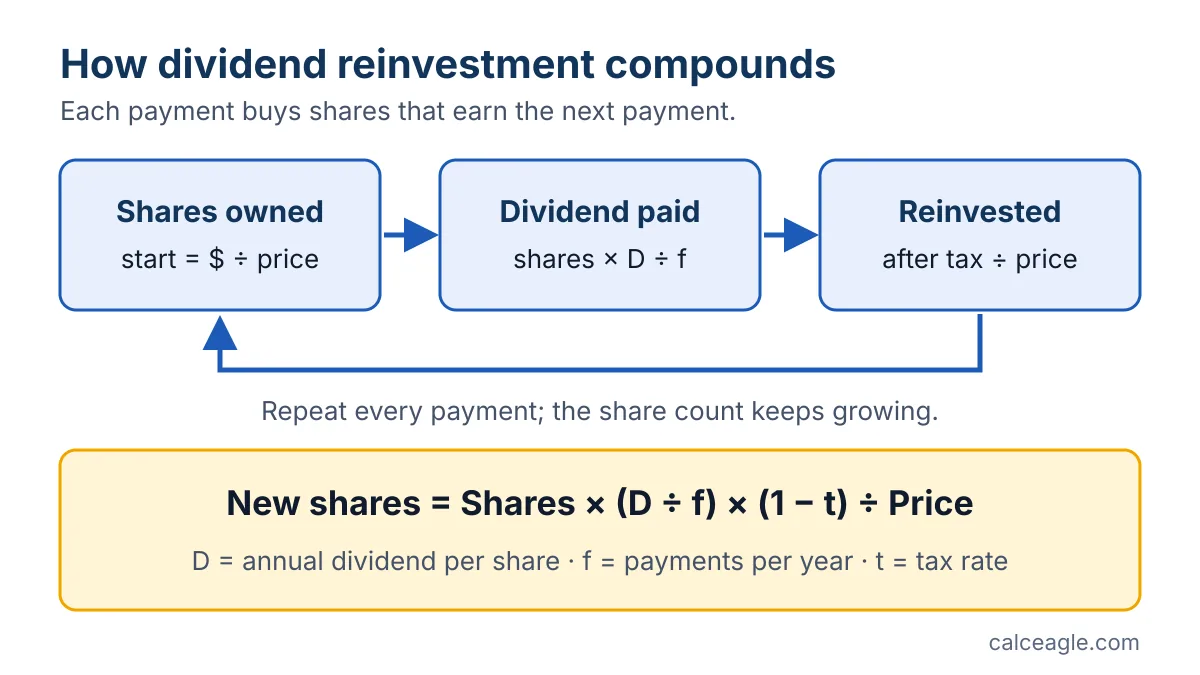
The calculator runs month by month and processes each dividend payment separately:
| Symbol | Meaning |
|---|---|
| Price₀ | Share price today |
| Yield | Starting annual dividend yield on today's price |
| g_div | Annual dividend growth rate |
| g_price | Annual share price growth rate |
| f | Payments per year (12, 4, 2 or 1) |
| t | Dividend tax rate (0 in a tax-advantaged account) |
Why a growing per-share dividend? Companies and funds pay a set amount per share, and the price moves separately. So the yield you enter only sets the year-1 dividend ($50 × 4% = $2.00 a share). After that, the dividend per share rises once a year by your dividend growth rate, while the price compounds at its own rate. If the price grows faster than the dividend, the current yield drifts down, and vice versa.
Timing assumptions. Each dividend is paid at the end of its period to the shares you own at that moment. The after-tax amount buys fractional shares at that day's price. Extra contributions are invested at the end of each month or year, after any dividend paid that day, so new shares start earning with the next payment. That matches the ex-dividend rule: shares bought on or after the ex-dividend date do not receive that payment (Investor.gov). No fees or commissions are deducted.
Example: $10,000 in a quarterly dividend payer
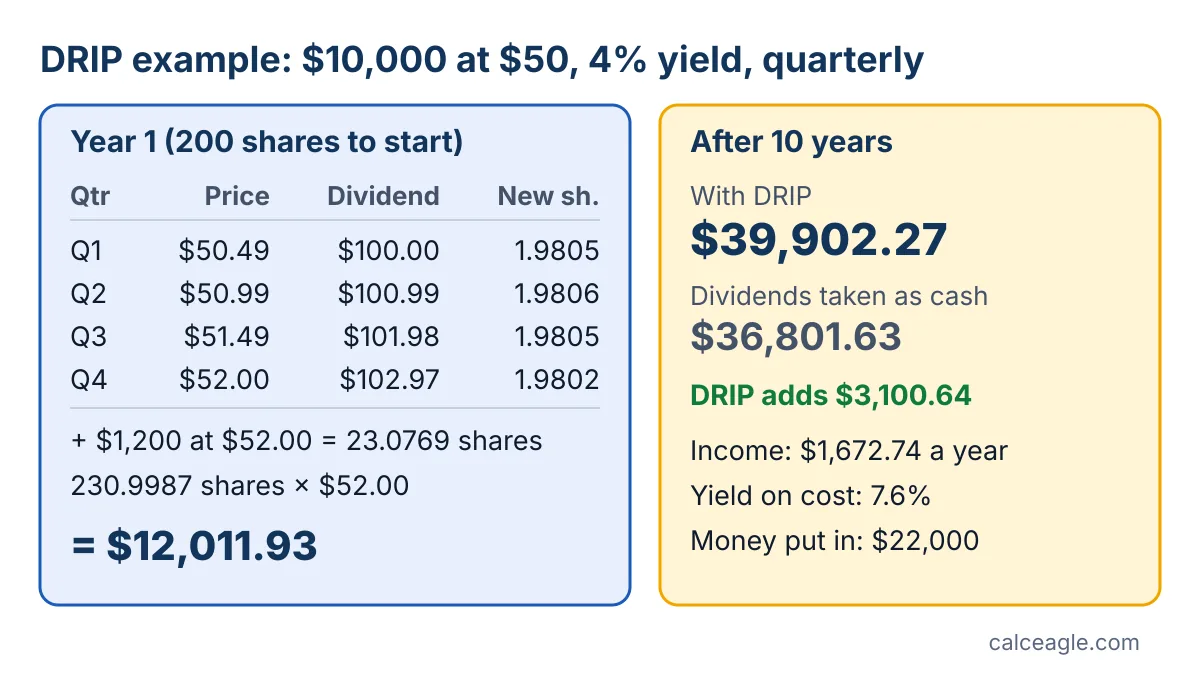
You invest $10,000 at $50.00 a share, so you start with 200 shares. The yield is 4%, which is $2.00 per share a year, paid as $0.50 each quarter. You expect the dividend to grow 5% a year and the price to grow 4% a year, and you add $1,200 at the end of each year. The account is an IRA, so the tax rate is 0%.
| Quarter | Share price | Dividend (shares × $0.50) | Shares bought | Shares after |
|---|---|---|---|---|
| Q1 | $50.49 | $100.00 | 1.9805 | 201.9805 |
| Q2 | $50.99 | $100.99 | 1.9806 | 203.9611 |
| Q3 | $51.49 | $101.98 | 1.9805 | 205.9416 |
| Q4 | $52.00 | $102.97 | 1.9802 | 207.9218 |
Each payment is slightly larger than the last because it is paid on more shares. At year-end, the $1,200 contribution buys $1,200 ÷ $52.00 = 23.0769 shares, for 230.9987 shares worth $12,011.93. In year 2 the dividend rises to $2.00 × 1.05 = $2.10 a share ($0.525 a quarter).
After 10 years the calculator shows:
- Ending balance: 539.1309 shares × $74.0122 ≈ $39,902.27 (shares and prices are rounded for display)
- Total contributions: $22,000.00, and total dividends received: $9,191.48
- Annual dividend income at the end: 539.1309 × $3.10266 (the year-10 dividend per share) ≈ $1,672.74 a year
- Yield on cost: $1,672.74 ÷ $22,000 = 7.6%
- Taking dividends as cash instead: $36,801.63, which includes $7,591.86 of cash dividends. Reinvesting adds $3,100.64.
How to read the result
- Ending balance is the market value of your shares, plus any dividends kept as cash. It is in future dollars, not adjusted for inflation.
- Total dividends received is the gross amount before tax, added up over every payment.
- Annual dividend income at the end is your final share count times the final year's dividend per share. It is a run rate, not a promise.
- Yield on cost compares that income with the money you put in. A high yield on cost after many years does not mean a new buyer would earn that yield today.
- Extra value from reinvesting is the DRIP balance minus the cash version. It grows with time, yield and dividend growth. If you enter a falling share price, the cash version can come out ahead, because shares bought with dividends lose value while the cash in this model does not.
Using it as an SCHD DRIP calculator
The calculator works for any dividend stock or fund, including the Schwab U.S. Dividend Equity ETF (SCHD). It does not store any fund's numbers, because yields and payouts change. To set up your own example:
- Open the fund provider's page. Schwab's SCHD page lists a 30-day SEC yield and a trailing 12-month distribution yield, each with an as-of date, plus a distribution history (Schwab Asset Management). Enter the current price and the yield you choose, and note its date.
- The distribution history lists four payments a year, with ex-dates in March, June, September and December, so pick Quarterly.
- For Dividend growth, add up the last four payments and the four payments from five years earlier, then compute (recent ÷ earlier)^(1/5) − 1. To average year-over-year growth rates instead, use the Geometric Mean Calculator.
- Choose a price growth rate you consider reasonable, and try a lower one too.
Past distribution growth does not guarantee future growth, so treat the result as one scenario, not a forecast.
Taxes on reinvested dividends
In a taxable account, reinvesting does not defer tax. The IRS says dividends used to buy more shares must still be reported as income with your other dividends (IRS). Qualified dividends are taxed at the lower capital gain rates, while other ordinary dividends are taxed as ordinary income (IRS Topic 404). Because your rate depends on your income and the type of dividend, the calculator applies one flat rate that you choose to every payment. Keep your statements: every reinvestment is a separate purchase with its own date and price.
Assumptions and limitations
- Growth rates are constant. Real dividends and prices move unevenly, and dividends can be cut or suspended.
- Fees are ignored. Investor.gov notes that companies or brokers may charge for dividend reinvestment, so check your plan (Investor.gov).
- Reinvestment buys fractional shares at the payment-date price, with no discount.
- Tax is taken from each payment instead of at tax time, and dividends held as cash earn no interest.
- Results are not adjusted for inflation.
Common mistakes
- Typing the yield as a decimal. Enter 4 for a 4% yield, not 0.04.
- Using total return as price growth. Total return already includes dividends, so it double counts them here. Use price growth only.
- Confusing yield on cost with current yield. Yield on cost uses your contributions, not today's price.
- Ignoring taxes in a taxable account. Even a 15% rate noticeably slows compounding over decades.
- Projecting a recent growth spurt for 30 years. Run a lower dividend growth rate as well and compare.
Note: Results are estimates for education only, not investment, tax or financial advice. They assume constant growth rates, one flat tax rate on dividends, no fees, and fractional-share reinvestment at the payment-date price. Past dividends and returns do not guarantee future results.
Frequently asked questions
What is a DRIP?
A dividend reinvestment plan automatically uses your cash dividends to buy more shares of the same stock or fund. Companies offer them directly, and brokerage firms and funds may offer reinvestment too. Check whether your company or firm charges for the service.
Do I pay taxes on reinvested dividends?
Yes, in a taxable account. The IRS treats reinvested dividends as income in the year they are paid, the same as dividends you take in cash. In an IRA or 401(k), enter 0% as the tax rate.
Is reinvesting dividends always better than taking cash?
Not always. Reinvesting comes out ahead when the share price holds up or rises, because the extra shares earn more dividends. If the price falls steadily, shares bought with dividends lose value. For example, $10,000 at $50 with a 4% yield paid quarterly, a flat dividend and a 10% yearly price decline ends at $7,103.53 with DRIP but $7,486.78 with cash after 10 years. Try your own scenarios.
How do I use this as an SCHD DRIP calculator?
Look up SCHD's current price, yield and distribution history on the fund provider's page. Enter the price and yield, pick Quarterly, and estimate dividend growth from past distributions. The calculator does not store any fund's figures, so your result reflects the numbers you enter.
What is yield on cost?
Yield on cost is your current annual dividend income divided by the money you invested. If $22,000 of contributions now produce $1,672.74 a year, your yield on cost is 7.6%, even if the stock's current yield is lower.
Sources and references
- Direct Investment Plans: Buying Stock Directly — Investor.gov (U.S. Securities and Exchange Commission)
- Ex-Dividend Dates — Investor.gov (U.S. Securities and Exchange Commission)
- Stocks (Options, Splits, Traders) FAQs: How are reinvested dividends reported on my tax return? — Internal Revenue Service
- Topic no. 404, Dividends — Internal Revenue Service
- Schwab U.S. Dividend Equity ETF (SCHD) — Schwab Asset Management
Formulas and content last reviewed on October 13, 2026. Last updated October 13, 2026. Results are estimates for general information only. Spotted a problem? Tell us and we will check it.