Barbell Calculator
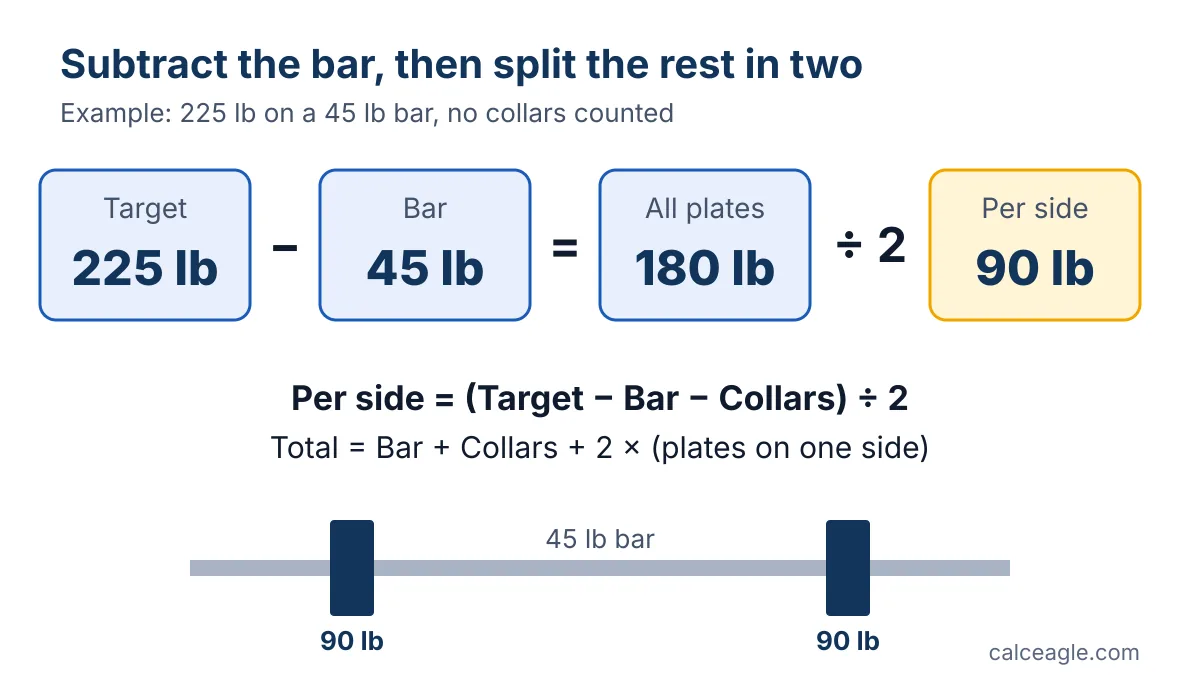
To load a barbell, subtract the bar's weight from your target and split the rest evenly between the two sides. 225 lb on a 45 lb bar is 90 lb per side: two 45 lb plates on each side. In the same way, 135 lb is one 45 per side, 315 lb is three and 405 lb is four.
This calculator picks plates from the ones your gym actually has, including limited pairs, shows the nearest possible loads when the exact weight can't be made, and can also add up a bar that is already loaded.

How to use the barbell calculator
- Choose Pounds (lb) or Kilograms (kg).
- Under What do you want to find? pick Plates for a target weight, or Total from plates on the bar to add up a bar that is already loaded.
- Enter the Target total weight, meaning everything you will lift: bar, collars and plates.
- Choose the Bar weight. Pick Custom… for a technique bar, a trap bar or any bar with an unusual weight, and weigh it if it isn't marked.
- If you count your collars, enter Collars, both together. Competition collars weigh 2.5 kg each, so a pair is 5 kg.
- Under Plates you have, untick sizes your gym doesn't stock. If you only have a few pairs of a size, type how many pairs; leave the box blank for no limit.
- Pick a Loading style and press Calculate. You get the plates for each side, a picture of one side of the bar, and the nearest possible loads if the exact weight can't be made.
Barbell plate formula
| Term | Meaning |
|---|---|
| Target | The total you want to lift |
| Bar | The empty bar, such as 45 lb or 20 kg |
| Collars | Both collars together (enter 0 or leave blank if you ignore them) |
| Weight per side | What the plates on one sleeve must add up to |
Once it knows the weight per side, the calculator searches the plates you ticked for an exact combination. Heaviest plates first uses as many of the biggest plates as possible, then works down through the smaller sizes. Fewest plates finds the combination with the fewest plates per side. The two usually agree, but with 35 lb plates in the mix they can differ: 60 lb per side is 45 + 10 + 5 heaviest-first, but only two plates (35 + 25) with the fewest-plates setting. The search is exact, so it still works when a limited number of pairs would trip up a simple largest-plate-first approach.
Example: loading 225 lb for the bench press
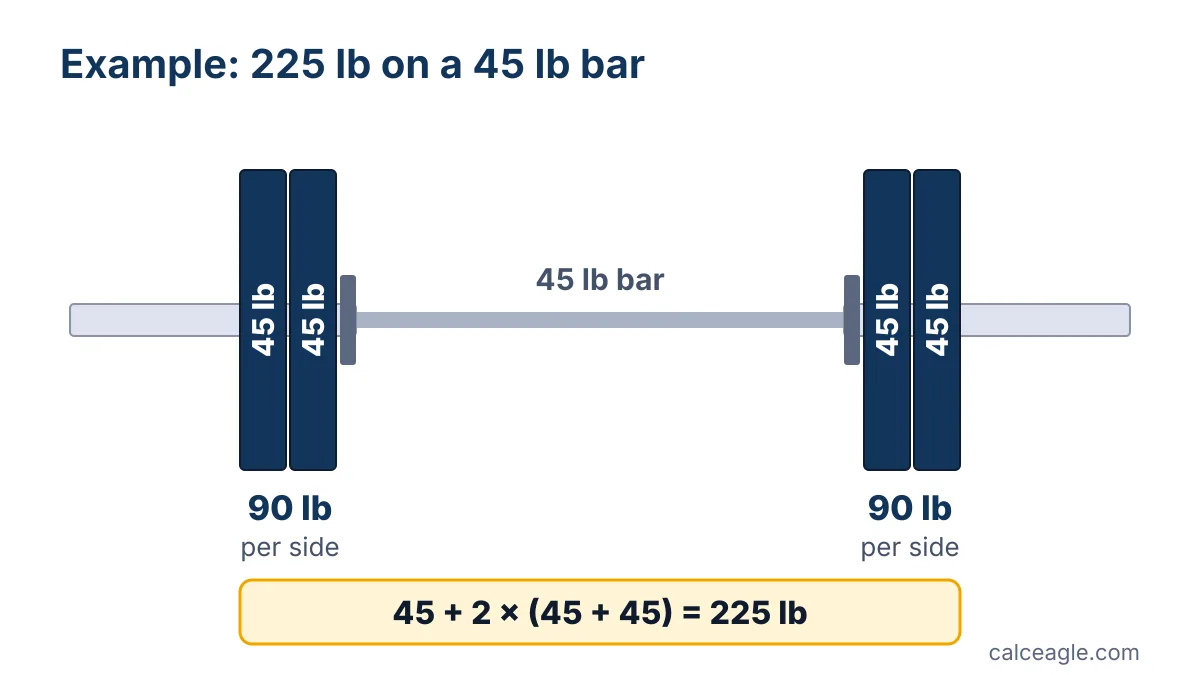
You want 225 lb on a standard 45 lb bar and you aren't counting collars.
- Plates needed in total: 225 − 45 = 180 lb
- Per side: 180 ÷ 2 = 90 lb
- 90 lb = 45 + 45, so put two 45 lb plates on each side
Two other common cases work the same way. For 185 lb, (185 − 45) ÷ 2 = 70 lb per side, which is 45 + 25. In kilograms, 100 kg on a 20 kg bar is (100 − 20) ÷ 2 = 40 kg per side: a 25 kg plate and a 15 kg plate.
Quick reference: 45 lb bar
| Total | Per side | Plates on each side |
|---|---|---|
| 95 lb | 25 lb | 25 |
| 135 lb | 45 lb | 45 |
| 155 lb | 55 lb | 45 + 10 |
| 185 lb | 70 lb | 45 + 25 |
| 205 lb | 80 lb | 45 + 35 |
| 225 lb | 90 lb | 45 + 45 |
| 275 lb | 115 lb | 45 + 45 + 25 |
| 315 lb | 135 lb | 45 + 45 + 45 |
| 365 lb | 160 lb | 45 + 45 + 45 + 25 |
| 405 lb | 180 lb | 45 + 45 + 45 + 45 |
How to read the result
- Plates on each side lists the plates for one sleeve, heaviest first. Slide them on in that order so the heaviest plate sits closest to the center, then repeat on the other side.
- If the exact total isn't possible, you get the nearest load below and above and how far each is from your target. When every plate size is a multiple of your smallest plate, as with standard pound plates, totals change in steps of twice the smallest plate: 5 lb steps with 2.5 lb plates, or 2.5 lb steps once you add 1.25 lb plates.
- If your limited plates can't reach the target, the calculator says so and shows the heaviest load you can make.
- The other-unit figure uses the exact definition 1 lb = 0.45359237 kg. A bar stamped 20 kg weighs about 44.1 lb, so treating it as 45 lb overstates your total by roughly 0.9 lb.
Kilogram plate colors
The International Weightlifting Federation (IWF) color-codes competition discs, which helps you load quickly:
| Disc | Color | Disc | Color |
|---|---|---|---|
| 25 kg | Red | 2.5 kg | Red |
| 20 kg | Blue | 2 kg | Blue |
| 15 kg | Yellow | 1.5 kg | Yellow |
| 10 kg | Green | 1 kg | Green |
| 5 kg | White | 0.5 kg | White |
The IWF lists a 20 kg bar for men and a 15 kg bar for women, plus 2.5 kg collars. Colors on gym plates are a convenience, not a guarantee, so always read the number on the plate. The plate picture in the results uses these colors for kilogram plates and neutral blues for pound plates.
Assumptions and limitations
- Both sides are loaded identically.
- Plates and bars are assumed to weigh exactly what they are marked. Real gym equipment can be off by a small amount.
- The calculator does not check whether the plates physically fit on the sleeve.
- Targets are limited to 2,000 lb or 1,000 kg.
Note: This calculator only does the arithmetic. It can't tell you whether a weight is safe for you. Use collars, safety arms or a spotter for heavy lifts, and follow your coach's or health professional's advice.
Common mistakes
- Forgetting the bar. Loading 225 lb of plates on a 45 lb bar gives 270 lb, not 225.
- Mixing up "per side" and "total." "Two plates" usually means one on each side; this calculator always lists plates per side.
- Assuming every bar is 45 lb. Women's bars, technique bars and specialty bars weigh different amounts. Choose Custom… if yours isn't listed.
- Mixing pound and kilogram plates without converting. A 20 kg plate is about 44.1 lb, not 45.
- Loading the sides unevenly, which tips the bar when you unrack it.
To track how much heavier your lifts get over time, try the Percentage Calculator for percent change.
Frequently asked questions
What plates do I need for 225 lb?
On a 45 lb bar, 225 − 45 = 180 lb of plates, or 90 lb per side. That is two 45 lb plates on each side.
How much does an Olympic barbell weigh?
The IWF specifies 20 kg (about 44.1 lb) for the men's bar and 15 kg (about 33.1 lb) for the women's bar. US gyms commonly count a standard bar as 45 lb. Check the end cap or ask staff if you're not sure.
Should I count the collars?
Competition totals include them: IWF collars weigh 2.5 kg each. In training it's your choice. Enter the pair's weight if you want the total to include them.
How do I figure out how much is on a loaded bar?
Add up the plates on one side, double it, and add the bar (and collars). Two 45s per side on a 45 lb bar is 2 × 90 + 45 = 225 lb. Use the Total from plates on the bar mode to do it automatically.
Why can't the calculator hit my exact weight?
Every total must equal the bar plus twice a combination of your plates. With 2.5 lb as the smallest plate, totals change in 5 lb steps, so 226 lb isn't possible; the calculator shows 225 lb and 230 lb instead.
Sources and references
- Weightlifting equipment (barbell, discs and collars) — International Weightlifting Federation (IWF)
- NIST Guide to the SI, Appendix B.9: Factors for units listed by kind of quantity — National Institute of Standards and Technology (NIST)
Formulas and content last reviewed on October 13, 2026. Last updated October 13, 2026. Results are estimates for general information only. Spotted a problem? Tell us and we will check it.