Brick Calculator
To estimate bricks, divide the net wall area by the face area of one brick plus its mortar joint: bricks per sq ft = 144 ÷ ((length + joint) × (height + joint)). Modular brick (7 5/8 × 2 1/4 in) with 3/8 in joints works out to about 6.86 bricks per sq ft, so a 196 sq ft wall needs 1,344 bricks, or 1,412 with 5% waste.
This calculator subtracts doors and windows, covers the common Brick Industry Association sizes plus custom bricks, rounds up to whole bricks, and adds an optional cost and mortar estimate.
How to use the Brick Calculator
- Choose Feet & inches or Metric (m, mm).
- Enter the Wall length and Wall height. If several walls share the same height, add their lengths together and run them as one wall.
- Under Doors and windows to subtract, enter how many doors and windows the wall has and their rough-opening sizes. If you already know the total opening area, switch to Total area instead.
- Pick a Brick size. Choose Custom size to type the length, height and (optionally) width from your brick's data sheet. Fractions such as 7 5/8 work.
- Set the Mortar joint thickness (3/8 in is typical) and a Waste allowance.
- Add a Price per brick if you want a cost estimate, then press Calculate.
Brick calculator formula
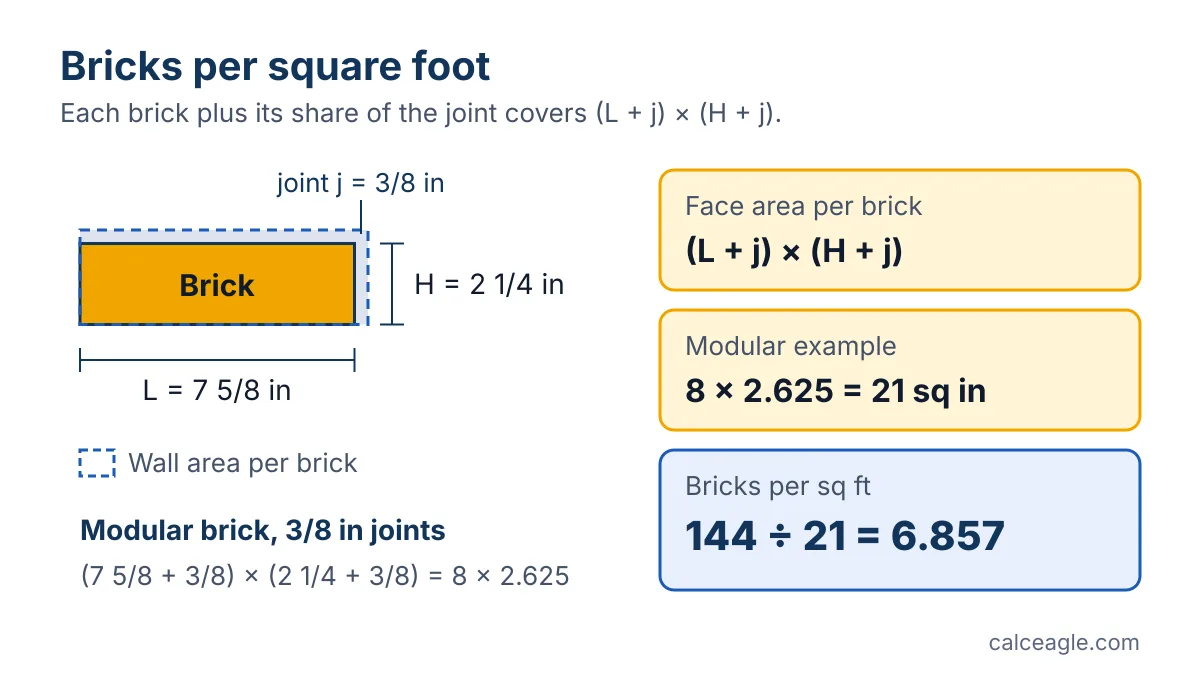
Each brick, together with half of the mortar joint around it, covers a rectangle of wall that is one joint longer and one joint taller than the brick itself. Dividing the wall area by that rectangle gives the brick count.
| Symbol | Meaning |
|---|---|
| L | Actual brick length, in |
| H | Actual brick height, in |
| W | Actual brick width (bed depth), in, used only for mortar |
| j | Mortar joint thickness, in |
| 144 | Square inches in a square foot (in metric mode, 1,000,000 mm² per m²) |
The mortar line is the volume of one bed joint under the brick plus one head joint at its end. It is a geometric method that reproduces the Brick Industry Association (BIA) mortar quantities for modular units, such as 8.1 cu ft per 1,000 modular brick with 3/8 in joints.
Example: brick veneer on a 30-foot wall
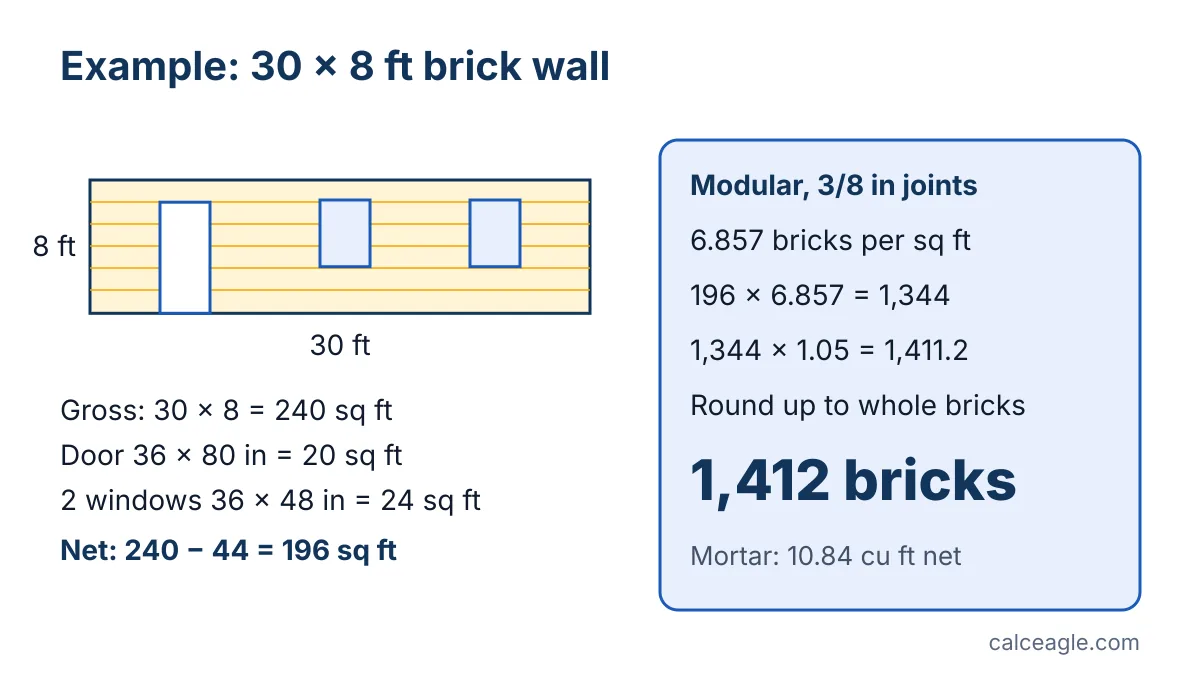
A homeowner is facing a 30 ft long, 8 ft high wall with modular brick and 3/8 in joints. The wall has one 36 × 80 in door and two 36 × 48 in windows, and the plan uses a 5% waste allowance.
- Gross area: 30 × 8 = 240 sq ft.
- Door: 36 × 80 = 2,880 sq in = 20 sq ft. Windows: 2 × 36 × 48 = 3,456 sq in = 24 sq ft. Openings total 44 sq ft.
- Net area: 240 − 44 = 196 sq ft.
- Face area per brick: (7 5/8 + 3/8) × (2 1/4 + 3/8) = 8 × 2.625 = 21 sq in, so 144 ÷ 21 = 6.857 bricks per sq ft.
- Bricks before waste: 196 × 6.857 = 1,344.
- With waste: 1,344 × 1.05 = 1,411.2, rounded up to 1,412 bricks.
- If a supplier quotes $0.85 per brick, the bricks cost 1,412 × $0.85 = $1,200.20.
- Mortar: 3 5/8 × 3/8 × (7 5/8 + 2 1/4 + 3/8) = 13.93 cu in per brick. For 1,344 bricks that is 10.84 cu ft, or 12.46 to 13.55 cu ft after BIA's 15% to 25% mortar waste.
How to read the result
- Bricks to order is the number to buy. It already includes your waste allowance and is rounded up to whole bricks. Ask your supplier how many bricks come in a cube or pallet so you can round to full packs.
- Bricks per sq ft lets you compare with published tables. For modular brick with 3/8 in joints the calculator gives 6.86, while BIA Technical Note 10 lists 675 per 100 sq ft (6.75). BIA's figure uses the nominal 8 × 2 2/3 in module, in which three courses equal 8 in, so the bed joints are slightly thicker than 3/8 in. The 1.6% gap is smaller than the waste allowance and errs on the side of having enough brick. For standard, queen, king, utility and closure sizes, the calculator matches BIA's table to the nearest brick per 100 sq ft.
- Mortar is the wet volume of mortar in the joints. To turn it into bags, divide by the yield printed on your mortar mix bag.
Brick sizes and coverage
| Brick | Actual size W × H × L (in) | Bricks per sq ft, 3/8 in joints | BIA Table 4, per 100 sq ft |
|---|---|---|---|
| Modular | 3 5/8 × 2 1/4 × 7 5/8 | 6.86 | 675 |
| Standard | 3 5/8 × 2 1/4 × 8 | 6.55 | 655 |
| Queen | 3 × 2 3/4 × 8 | 5.50 | 550 |
| King | 3 × 2 3/4 × 9 3/4 | 4.55 | 455 |
| Utility | 3 5/8 × 3 5/8 × 11 5/8 | 3.00 | 300 |
| Closure (modular) | 3 5/8 × 3 5/8 × 7 5/8 | 4.50 | 450 |
Queen and king brick are non-modular, and their sizes vary. BIA lists queen brick at 2 3/4 or 3 in thick and 7 5/8 or 8 in long, and king brick at 2 5/8 or 2 3/4 in high and 9 5/8 or 9 3/4 in long. Names vary too: Belden Brick, for example, sells a 3 1/8 × 2 3/4 × 9 5/8 in unit as a "queen." When in doubt, choose Custom size and enter the dimensions from your product's data sheet.
Assumptions and limitations
- The wall is one wythe (a single layer of brick) laid in running bond or stack bond. Patterns with header courses, such as Flemish or English bond, need more brick; BIA publishes correction factors for them.
- The default 5% waste is BIA's suggested minimum for brick. Raise it to around 10% for walls with many corners, openings and cuts, or if you are new to bricklaying.
- Openings use the rough-opening size. The calculator does not add brick for sills, soldier courses or arches, and it does not count wall ties, flashing or lintels.
- Mortar is a theoretical joint volume. BIA recommends adding 15% to 25% for mortar waste, which is why the result shows that range. Collar joints and grout fill in multi-wythe walls are not included.
- Results are estimates. Confirm brick dimensions and coursing with the manufacturer's data sheet and your mason before you order.
Note: This calculator is a planning tool, not engineering or code advice. Brick veneer details such as ties, flashing, weep holes and lintels are governed by your local building code; check with your building department or a licensed contractor.
Common mistakes
- Using nominal instead of actual size. A modular brick is nominally 4 × 2 2/3 × 8 in, but that size already includes the joint. Entering the nominal size plus a 3/8 in joint counts the joint twice and undercounts brick by about 18%.
- Subtracting openings twice. Use either By size or Total area, not both.
- Trusting the size name alone. Queen, king and other names do not mean the same dimensions at every brickyard.
- Skipping the waste allowance. Broken brick and cut pieces at corners and openings add up, and running short means waiting for another delivery.
- Applying the waste percentage to mortar twice. Mortar waste is added to the net brick count, not to the count that already includes brick waste.
Working on the inside of the room too? The Drop Ceiling Calculator estimates ceiling grid and panels, and the Grout Calculator covers tile grout. To figure a waste percentage or a markup on a quote, use the Percentage Calculator.
Frequently asked questions
How many bricks are in a square foot?
It depends on the brick size and joint. With 3/8 in joints: modular about 6.86 (BIA's table lists 6.75 using nominal coursing), standard 6.55, queen 5.50, king 4.55, closure 4.50 and utility 3.00 bricks per sq ft.
How many bricks do I need for a 10 × 10 ft wall?
A 10 × 10 ft wall is 100 sq ft. With modular brick and 3/8 in joints: 100 × 6.857 = 685.7, rounded up to 686 bricks, or 720 bricks with 5% waste (685.7 × 1.05 = 720). Subtract any openings first.
How much mortar do I need per 1,000 bricks?
BIA Technical Note 10 lists about 8.1 cu ft of mortar per 1,000 modular brick with 3/8 in joints and about 10.3 cu ft with 1/2 in joints, before waste. BIA recommends adding 15% to 25% for mortar waste.
How much extra brick should I order?
BIA suggests adding at least 5% to the net quantity. Many cuts, corners and openings, or a first-time DIY project, justify going closer to 10%.
What is the difference between nominal and actual brick size?
The nominal size includes one mortar joint; the actual (specified) size is the brick itself. A modular brick is nominally 4 × 2 2/3 × 8 in and actually 3 5/8 × 2 1/4 × 7 5/8 in when laid with 3/8 in joints. Enter actual sizes in this calculator.
Sources and references
- Technical Note 10: Dimensioning and Estimating Brick Masonry — Brick Industry Association
- Estimating Masonry (CE 4333 lecture notes) — Michigan Technological University
- Brick Dimensions Guide — The Belden Brick Company
Formulas and content last reviewed on October 13, 2026. Last updated October 13, 2026. Results are estimates for general information only. Spotted a problem? Tell us and we will check it.