Exponential Decay Calculator
Exponential decay means a quantity loses the same percentage of what is left in every equal period. With a percent rate it is N = N₀(1 − r)^t; with a continuous constant, N = N₀e^(−kt); with a half-life, N = N₀(1/2)^(t/T½).
For example, 30,000 shrinking 15% per year leaves 30,000 × 0.85⁵ ≈ 13,311.16 after 5 years, and carbon-14, with a half-life of about 5,730 years, falls to about 29.8% of its original amount in 10,000 years.
How to use the Exponential Decay Calculator
- Under How is the decay described?, pick the form your problem uses: Percent per period (for example, 15% per year), Decay constant (k) (the k in e^(−kt)) or Half-life.
- Under Solve for, choose Amount remaining or Time.
- Enter the Initial amount (N₀) and choose a Time unit. Use the same unit for the rate, k, half-life and time.
- Enter the Decay rate (r), Decay constant (k) or Half-life (T½).
- Enter the Time elapsed (t) to find the amount left, or the Final amount (N) to find how long it takes.
- Press Calculate. Besides the answer, the result converts your parameter into the other two forms (r, k and T½) and shows the steps.
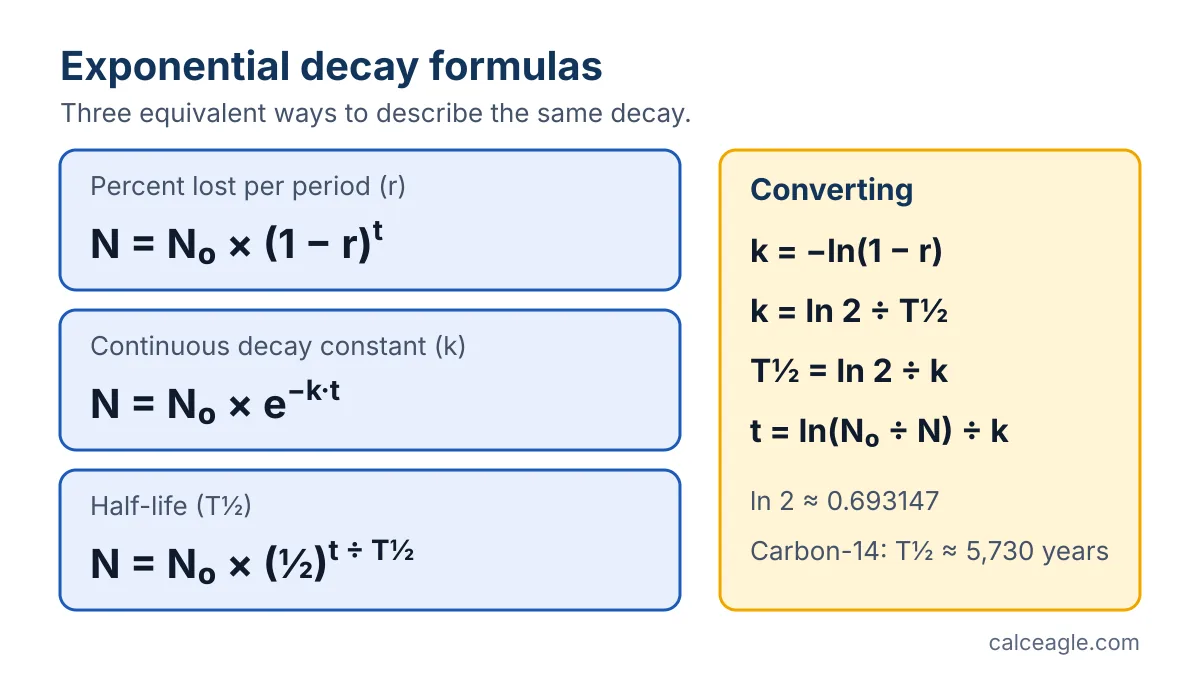
Exponential decay formulas
Exponential decay means the quantity loses the same fraction of what is left in every equal stretch of time. The three common ways of writing it are equivalent:
| Symbol | Meaning |
|---|---|
| N₀ | Initial amount at t = 0 |
| N | Amount remaining after time t |
| t | Time elapsed, in your chosen unit |
| r | Fraction lost per period (15% = 0.15) |
| k | Continuous decay constant, per unit of time (always positive here; the minus sign is in the formula) |
| T½ | Half-life: the time for any amount to fall by half |
Example: carbon-14 after 10,000 years
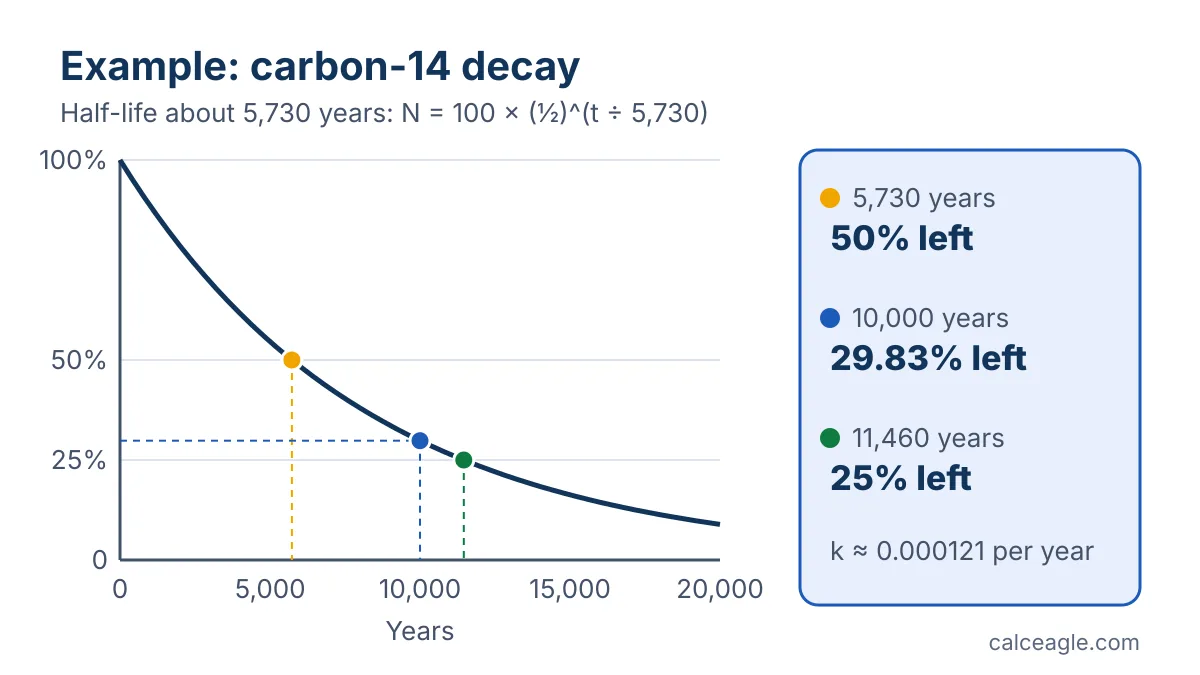
Carbon-14 has a half-life of about 5,730 years. How much of an original sample remains after 10,000 years?
- Number of half-lives: 10,000 ÷ 5,730 = 1.7452.
- Fraction left: (1/2)^1.7452 = 0.2983.
- Starting from 100 units, 29.83 remain, so a little under 30%.
The calculator also converts the half-life: k = ln 2 ÷ 5,730 = 0.000120968 per year, which is a loss of about 0.0121% per year. To find when only 25% remains, switch Solve for to Time: 25% is two halvings, so t = 2 × 5,730 = 11,460 years. Falling to 10% takes 5,730 × log₂ 10 ≈ 19,035 years.
Example: a car losing 15% of its value per year
The default inputs model a $30,000 vehicle that loses 15% of its remaining value each year (a declining-balance pattern):
| Year | Value |
|---|---|
| 0 | $30,000.00 |
| 1 | $25,500.00 |
| 2 | $21,675.00 |
| 3 | $18,423.75 |
| 4 | $15,660.19 |
| 5 | $13,311.16 |
After five years, 30,000 × 0.85⁵ = $13,311.16, or 44.37% of the original. The equivalent half-life is ln 2 ÷ −ln 0.85 ≈ 4.27 years. Actual resale values depend on the make, mileage and market, so treat this as a math model, not an appraisal.
Example: first-order elimination (math only)
Many textbook problems describe a substance cleared at a rate proportional to the amount present, with a constant such as k = 0.1 per hour. After 6 hours, e^(−0.6) = 0.5488, so 54.88% remains, and the half-life is 0.693147 ÷ 0.1 ≈ 6.93 hours. This illustrates the math only; it is not information about any real medication.
Rate, k and half-life side by side
The same decay can be stated three ways. For small rates, the half-life is roughly 69.3 ÷ (rate in percent).
| Rate per period (r) | k = −ln(1 − r) | Half-life (periods) |
|---|---|---|
| 1% | 0.01005 | 68.97 |
| 2% | 0.02020 | 34.31 |
| 5% | 0.05129 | 13.51 |
| 10% | 0.10536 | 6.58 |
| 15% | 0.16252 | 4.27 |
| 20% | 0.22314 | 3.11 |
| 50% | 0.69315 | 1.00 |
How to read the result
- Amount remaining (N) is in the same units as N₀: grams, dollars, people, percent.
- Percent remaining is N ÷ N₀ × 100 and does not depend on N₀.
- Number of half-lives elapsed is t ÷ T½. After 1, 2 and 3 half-lives, 50%, 25% and 12.5% remain.
- Mean lifetime (1/k) is the average time a unit of the quantity lasts, about 1.44 half-lives.
- Very small results are shown in scientific notation, such as 7.08 × 10^-1506.
Assumptions and limitations
- The rate stays constant over the whole time span. Real processes often change rate.
- The Percent per period form compounds once per period. The calculator allows fractional periods (such as 2.5 years) using the same formula.
- Exponential decay never reaches exactly zero, so a final amount of 0 is not allowed when solving for time. The final amount must also be no larger than the initial amount.
- Results are rounded for display, usually to four significant decimal places.
Note: Results are mathematical estimates. They are not appraisals, financial advice, or medical or dosing guidance. Scientists check real radiocarbon dates against independent records such as tree rings; this calculator applies only the decay formula.
Common mistakes
- Treating k and r as the same number. A 15% loss per period corresponds to k = 0.1625, not 0.15. Use the conversion rows instead of swapping one for the other.
- Mixing time units. If the half-life is in days, the elapsed time must also be in days.
- Typing k as a negative number. The formula already includes the minus sign, so enter k = 0.1, not −0.1.
- Subtracting a fixed amount each period. Losing $4,500 every year is linear depreciation; losing 15% of what is left is exponential.
To average growth or decline rates across several periods, use the Geometric Mean Calculator. For a one-time percent change, the Percentage Calculator is quicker.
Frequently asked questions
What is the exponential decay formula?
N = N₀(1 − r)^t when the rate r is a percent lost per period, or N = N₀e^(−kt) with a continuous decay constant k. With a half-life T½, use N = N₀(1/2)^(t/T½). All three describe the same kind of decay.
How do I convert a half-life to a decay constant?
Divide ln 2 (about 0.693147) by the half-life: k = ln 2 ÷ T½. For carbon-14 with T½ ≈ 5,730 years, k ≈ 0.000121 per year. Going the other way, T½ = ln 2 ÷ k.
How long does it take to decay to a certain amount?
Solve for time: t = ln(N₀ ÷ N) ÷ k, or t = T½ × log₂(N₀ ÷ N). Falling to 25% takes exactly two half-lives, so carbon-14 needs 2 × 5,730 = 11,460 years.
What is the difference between exponential and linear decay?
Linear decay subtracts the same amount each period (for example, $4,500 a year). Exponential decay removes the same percentage of what is left, so the drops get smaller over time and the amount never reaches zero.
Is a 15% decay rate the same as k = 0.15?
No. A 15% loss per period corresponds to k = −ln(1 − 0.15) ≈ 0.1625. The constant k = 0.15 means a loss of 1 − e^(−0.15) ≈ 13.93% per period. The calculator shows both conversions.
Sources and references
- How Do You Know the Age of Fossils and Other Old Things? — National Institute of Standards and Technology (NIST)
- 21.3 Radioactive Decay (Chemistry 2e) — OpenStax, Rice University
- 6.8 Exponential Growth and Decay (Calculus Volume 1) — OpenStax, Rice University
- Geologic Time: Radiometric Time Scale — U.S. Geological Survey (USGS)
Formulas and content last reviewed on October 13, 2026. Last updated October 13, 2026. Results are estimates for general information only. Spotted a problem? Tell us and we will check it.