G-Force Calculator
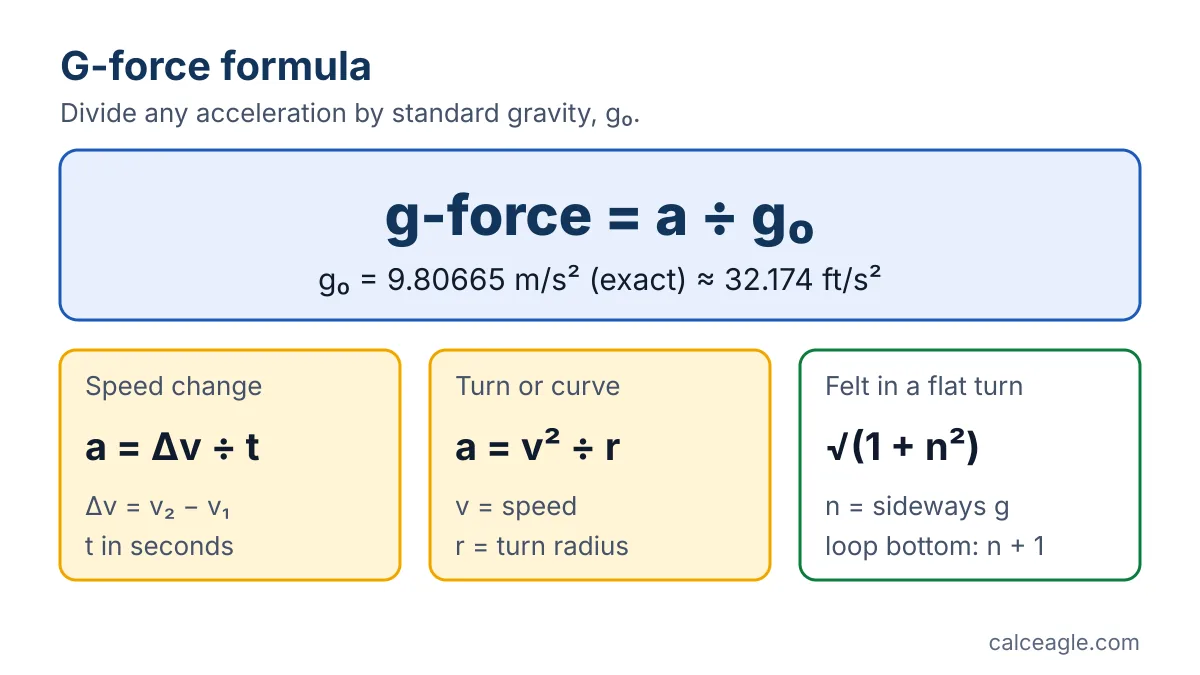
G-force is acceleration expressed in multiples of standard gravity, g₀ = 9.80665 m/s² (about 32.174 ft/s²): g = a ÷ 9.80665. A car that goes from 0 to 60 mph in 6.0 seconds averages 4.4704 m/s², or about 0.456 g.
This calculator finds g-force from an acceleration, from a change in speed over time, or from a turn's speed and radius (v²/r), and shows the load you actually feel once gravity is included.
How to use the G-Force Calculator
- Under What do you know?, choose one of three modes:
- Speed change over time for launches and braking, such as a 0–60 mph time.
- Turn or curve (v²/r) for cars on curves, airplanes in turns and roller coaster loops.
- Acceleration to convert a value in m/s² or ft/s² straight to g.
- Enter your numbers. For speed changes, fill in Starting speed, Ending speed, Speed unit (mph, km/h, m/s or ft/s) and Time in seconds. For turns, enter Speed, Turn radius and their units.
- Press Calculate. The answer is shown in g, m/s² and ft/s², with the steps. Turn mode also shows the load you would actually feel once gravity is included.
G-force formulas
A g-force is an acceleration divided by standard gravity, g₀ = 9.80665 m/s². That value is exact by definition, and because 1 ft is exactly 0.3048 m, it equals about 32.174 ft/s².
| Symbol | Meaning |
|---|---|
| a | Acceleration in m/s² (or ft/s²) |
| v₁, v₂ | Starting and ending speed |
| t | Time for the speed change, in seconds |
| v | Speed through the turn |
| r | Radius of the turn (half the diameter of the circle the path follows) |
| n | Sideways g-force from the turn, v²/r ÷ g₀ |
Speeds are converted with exact factors: 1 mph = 0.44704 m/s, 1 ft/s = 0.3048 m/s and 1 km/h = 1 ÷ 3.6 m/s.
Example: 0 to 60 mph in 6.0 seconds
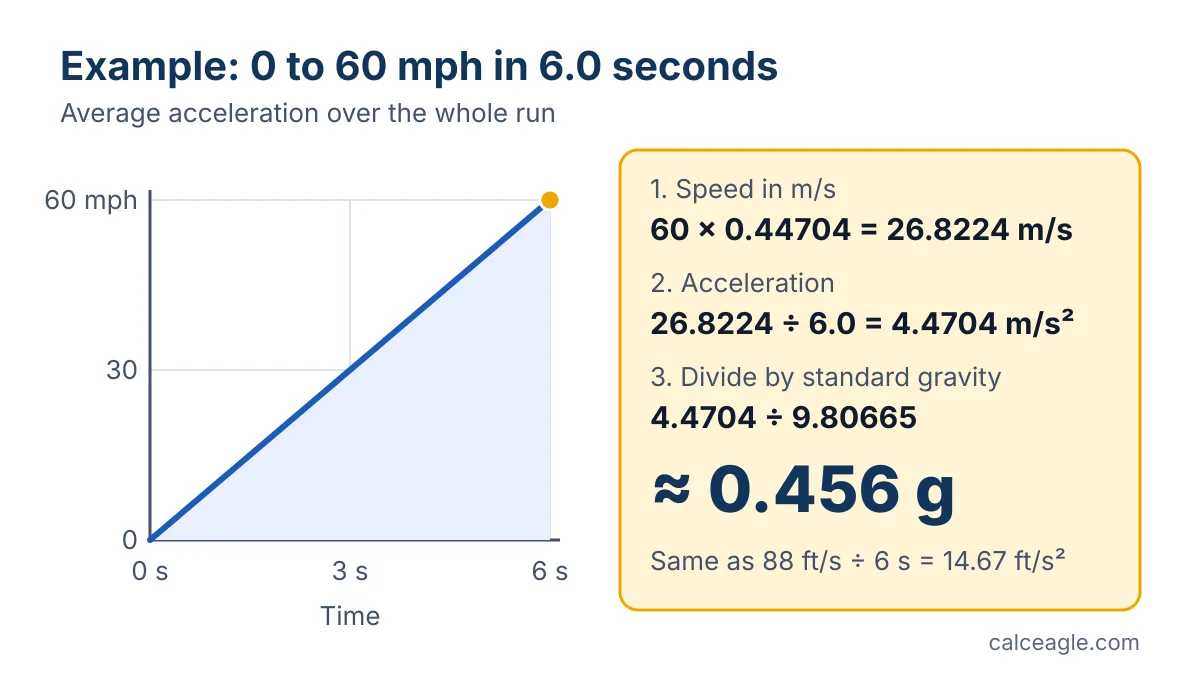
- Convert the speed: 60 mph × 0.44704 = 26.8224 m/s (or 88 ft/s).
- Average acceleration: 26.8224 ÷ 6.0 = 4.4704 m/s² (88 ÷ 6 = 14.67 ft/s²).
- Divide by standard gravity: 4.4704 ÷ 9.80665 = 0.456 g.
Braking from 60 mph to a stop in 3.0 seconds is the same calculation in reverse: −26.8224 ÷ 3 = −8.9408 m/s², or −0.912 g. The minus sign means the car is slowing down.
| Speed change | Time | Average g-force |
|---|---|---|
| 0 → 60 mph | 10 s | 0.274 g |
| 0 → 60 mph | 8 s | 0.342 g |
| 0 → 60 mph | 6 s | 0.456 g |
| 0 → 60 mph | 3 s | 0.912 g |
| 60 → 0 mph | 3 s | −0.912 g |
Example: a highway curve
A car takes a curve with a 300-foot radius at 45 mph. At 45 mph the car moves 66 ft/s, so a = 66² ÷ 300 = 14.52 ft/s², which is 0.451 g pushing sideways toward the center of the curve. Combined with gravity on a flat road, occupants feel √(1 + 0.451²) ≈ 1.097 g in total. A road banked at about 24.3° would line that combined force up with the seat, the same reason airplanes bank in turns.
Example: airplanes in a turn
OpenStax University Physics works an example of a jet flying at 134.1 m/s (about 300 mph) and finds that a turn radius of about 1.835 km gives a centripetal acceleration of 1 g. Entering 134.1 m/s and 1,835 m in turn mode gives 0.999 g.
For pilots, the felt load includes gravity. The FAA notes that in a 60° banked turn in level, coordinated flight, the load factor is 2 G's. The calculator reproduces this: at 300 mph on a 3,474-foot radius, the sideways acceleration is 1.732 g, the coordinated bank angle is 60°, and the felt load is √(1 + 1.732²) = 2.0 g.
Roller coaster loops
At the bottom of a vertical loop, the track has to supply the turning force and hold riders up against gravity, so riders feel n + 1 g. At the top, gravity already pulls toward the center, so they feel n − 1 g. As an illustration, a car moving 45 mph through the bottom of a curve with a 70-foot radius has n = 66² ÷ 70 ÷ 32.174 ≈ 1.934, so riders feel about 2.93 g. Use the speed and radius at each point of the ride, because both change around a real loop.
How to read the result
- Positive g in speed mode means speeding up; negative means slowing down.
- In turn mode the headline number is the sideways (centripetal) part only. The extra rows add gravity for a flat turn and for the bottom and top of a loop.
- 1 g equals the pull of standard gravity: 9.80665 m/s² or about 32.174 ft/s². Standing still, you already feel 1 g.
Assumptions and limitations
- Speed-change results are averages over the time you enter. Real launches and stops are uneven, so the peak g-force is higher than the average.
- Turn results assume a steady speed on a circular path of the radius you enter.
- The calculator uses standard gravity, a fixed conventional value, for every conversion.
- Results are rounded to three decimals in g and four in m/s² and ft/s².
Note: These are physics estimates for learning and planning. They are not safety ratings for vehicles, rides or aircraft, and they say nothing about how much g-force a particular person can tolerate.
Common mistakes
- Forgetting to convert units. Dividing 60 mph by 6 seconds gives 10 "mph per second," not m/s². Convert speeds to m/s or ft/s first; the calculator does this for you.
- Using the diameter as the radius. The radius of a 600-foot-wide circle is 300 feet.
- Treating v²/r as the total felt load. In a flat turn, gravity adds a second 1 g at a right angle, so the total is √(1 + n²).
- Mixing standard gravity values. Using 9.8 m/s² instead of 9.80665 m/s² changes results only slightly (about 0.07%), but use 9.80665 to match official conversions.
Interested in other science math? Try the Exponential Decay Calculator for half-life problems, or the Area of a Sector Calculator for arcs and curved paths.
Frequently asked questions
How do you calculate g-force?
Divide the acceleration by standard gravity, 9.80665 m/s² (or 32.174 ft/s²). An acceleration of 20 m/s² is 20 ÷ 9.80665 ≈ 2.04 g.
How many g's is 0 to 60 mph?
It depends on the time. 60 mph is 26.8224 m/s, so the average is 26.8224 ÷ t ÷ 9.80665: about 0.27 g in 10 seconds, 0.46 g in 6 seconds and 0.91 g in 3 seconds.
What is 1 g in ft/s² and m/s²?
Standard gravity is exactly 9.80665 m/s². Because one foot is exactly 0.3048 m, that is 9.80665 ÷ 0.3048 ≈ 32.174 ft/s².
How do you calculate g-force in a turn?
Use the centripetal acceleration a = v² ÷ r, then divide by 9.80665 m/s². At 45 mph (66 ft/s) on a 300-foot radius, a = 66² ÷ 300 = 14.52 ft/s² ≈ 0.451 g sideways.
Is the g-force I feel the same as my acceleration?
Not quite. Gravity adds to what you feel: standing still you feel 1 g with zero acceleration. In a flat turn the felt load is √(1 + n²); at the bottom of a loop it is n + 1. The FAA notes a 60° banked level turn produces a load factor of 2 G's.
Sources and references
- NIST Guide to the SI, Appendix B.8: Factors for Units Listed Alphabetically — National Institute of Standards and Technology (NIST)
- 4.4 Uniform and Nonuniform Circular Motion (University Physics Volume 1) — OpenStax, Rice University
- Advisory Circular 61-67C: Stall and Spin Awareness Training — Federal Aviation Administration (FAA)
Formulas and content last reviewed on October 13, 2026. Last updated October 13, 2026. Results are estimates for general information only. Spotted a problem? Tell us and we will check it.