Area of a Sector Calculator
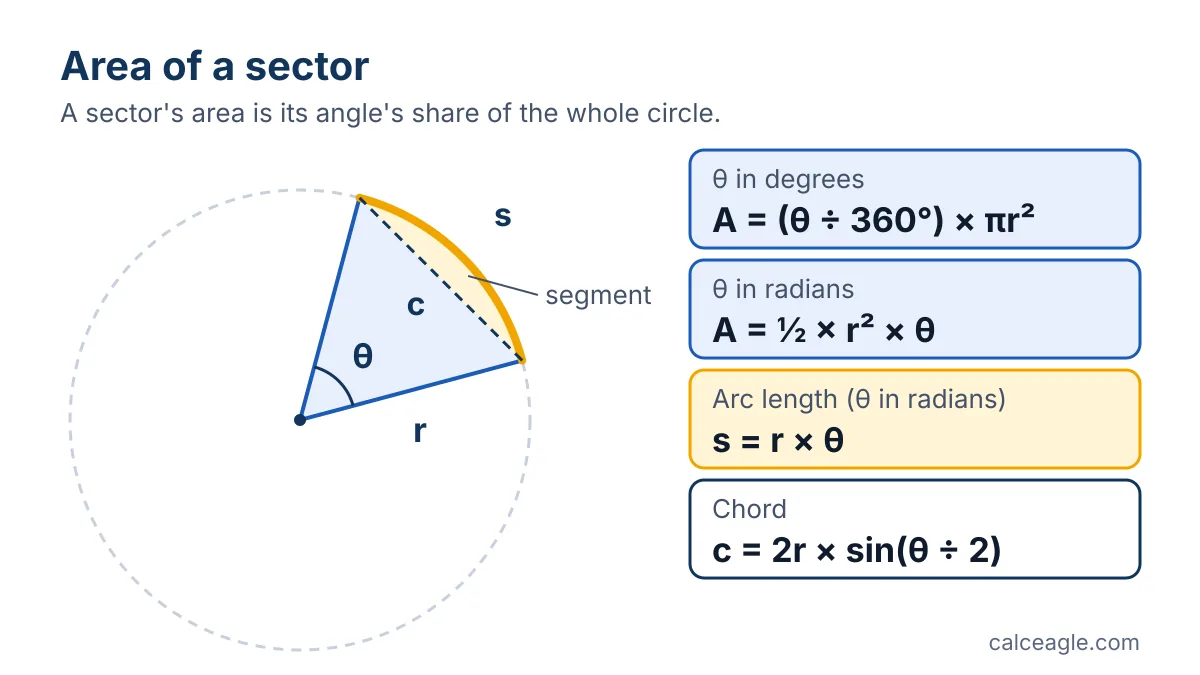
The area of a sector is the central angle's share of the whole circle: A = (θ ÷ 360°) × πr² with θ in degrees, or A = ½r²θ with θ in radians. One 45° slice of a 16-inch pizza (radius 8 inches) covers 8π ≈ 25.13 square inches.
Enter the radius or diameter with the angle, or the radius with the arc length, to get the sector area, arc length, chord, perimeter and segment area.

How to use the Area of a Sector Calculator
- Under What do you know?, choose Radius + angle, Radius + arc length or Diameter + angle.
- Enter the Radius (r) or Diameter (d).
- Enter the Central angle (θ) and pick Degrees (°) or Radians under Angle unit. The angle must be greater than 0 and no more than 360° (2π radians). In radians you can type a multiple of π, such as pi/3 or 3π/4. In arc-length mode, enter the Arc length (s) instead.
- Choose a Length unit so the results are labeled in square and linear units, or pick "no unit."
- Press Calculate. You get the sector area, arc length, chord length, sector perimeter and segment area, plus the angle in both units and the steps.
Area of a sector formula
A sector is the "pizza slice" region bounded by two radii and the arc between them. Its area is the same fraction of the full circle (πr²) as its angle is of a full turn:
| Symbol | Meaning |
|---|---|
| r | Radius, the distance from the center to the arc (half the diameter) |
| θ | Central angle between the two radii; radians = degrees × π ÷ 180 |
| s | Arc length, the curved edge of the sector |
| c | Chord, the straight line joining the two ends of the arc |
| P | Sector perimeter: two radii plus the arc |
The radian forms are simpler because a radian is defined by arc length: an angle of θ radians cuts off an arc of length rθ.
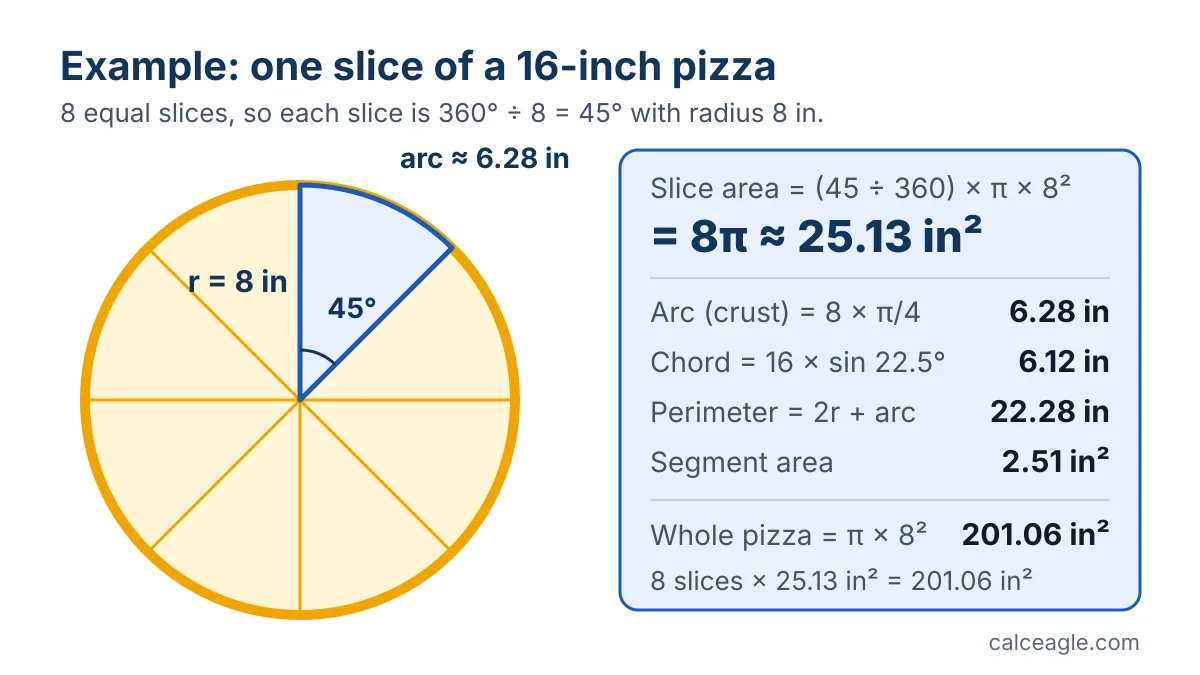
Example: one slice of a 16-inch pizza
A pizza that measures 16 inches across is cut into 8 equal slices. The radius is 16 ÷ 2 = 8 in, and each slice spans 360° ÷ 8 = 45°.
- Area: (45 ÷ 360) × π × 8² = 0.125 × 201.06 = 25.13 in² (exactly 8π).
- Arc length (the crust edge): 8 × (45 × π ÷ 180) = 8 × 0.785398 = 6.28 in.
- Chord (straight line across the crust ends): 2 × 8 × sin 22.5° = 6.12 in.
- Perimeter (both cut edges plus the crust): 8 + 8 + 6.28 = 22.28 in.
- Segment area (between the chord and the crust): ½ × 8² × (0.785398 − sin 45°) = 2.51 in².
Eight slices of 25.13 in² add back up to the whole pizza, 64π ≈ 201.06 in².
Example: lawn sprinkler coverage
A rotary sprinkler set to a 90° arc throws water 15 feet. The watered area is a quarter circle: (90 ÷ 360) × π × 15² ≈ 176.71 ft², and the outer edge of the pattern is 15 × π ÷ 2 ≈ 23.56 ft long. Set to 180°, the same head covers about 353.43 ft².
Sector vs. segment
A sector includes the center of the circle: two straight radii and a curved arc. A segment is the smaller region cut off by a straight chord, with no corner at the center. The segment area equals the sector area minus the triangle formed by the two radii and the chord.
When the angle is more than 180°, you have a major sector (more than half the circle). The calculator then reports the major segment, the larger piece on the arc side of the chord. At exactly 360°, the sector is the whole circle, the chord shrinks to a point and the "segment" is the full circle area.
Common angles in degrees and radians
| Degrees | Radians | Share of circle | Sector area |
|---|---|---|---|
| 30° | π/6 ≈ 0.5236 | 1/12 | πr² ÷ 12 |
| 45° | π/4 ≈ 0.7854 | 1/8 | πr² ÷ 8 |
| 60° | π/3 ≈ 1.0472 | 1/6 | πr² ÷ 6 |
| 90° | π/2 ≈ 1.5708 | 1/4 | πr² ÷ 4 |
| 120° | 2π/3 ≈ 2.0944 | 1/3 | πr² ÷ 3 |
| 180° | π ≈ 3.1416 | 1/2 | πr² ÷ 2 |
| 270° | 3π/2 ≈ 4.7124 | 3/4 | 3πr² ÷ 4 |
| 360° | 2π ≈ 6.2832 | whole circle | πr² |
How to read the result
- Sector area is in square units (in², ft², m²…). Arc, chord and perimeter are lengths in the unit you chose.
- Share of the full circle is θ ÷ 360°; it tells you what fraction of the whole circle the sector covers.
- The chord is always shorter than the arc; for very small angles the two are nearly equal.
- In Radius + arc length mode, the angle is worked out for you (θ = s ÷ r) and shown in degrees and radians.
Assumptions and limitations
- The shape is part of a perfect circle with a single, constant radius. Real objects (garden beds, slices) are only approximately circular.
- The angle must be greater than 0 and at most 360° (or 2π radians), and an arc cannot be longer than the full circumference 2πr.
- Results are rounded for display to four decimal places (six for the angle in radians).
Common mistakes
- Using degrees in the radian formula. ½r²θ needs θ in radians; with θ = 45 instead of 0.785, the answer is about 57 times too big.
- Entering the diameter as the radius. A 16-inch pizza has an 8-inch radius. Use Diameter + angle if you measured across.
- Confusing arc length with chord length. The arc is curved; the chord is the straight shortcut between its ends.
- Leaving out the radii in the perimeter. A sector's perimeter is the arc plus two radii.
Working with three-dimensional shapes? The Cube Calculator finds volume and surface area from any one measurement. For quick arithmetic, use the Basic Calculator.
Frequently asked questions
How do you find the area of a sector?
Divide the central angle by 360° and multiply by the circle's area: A = (θ ÷ 360°) × πr². For a 45° sector with an 8-inch radius: 0.125 × π × 64 ≈ 25.13 in².
What is the area of a sector formula in radians?
A = ½r²θ, with θ in radians. A sector with radius 3 and an angle of 2 radians has an area of ½ × 9 × 2 = 9 square units.
How do you find the area of a sector from the arc length?
Use A = ½ × r × s, where s is the arc length. With r = 12 and s = 10, the area is ½ × 12 × 10 = 60 square units, and the angle is s ÷ r ≈ 0.8333 rad (47.75°).
What is the difference between a sector and a segment?
A sector is bounded by two radii and an arc, so it includes the circle's center. A segment is bounded by a chord and an arc. Segment area = sector area minus the triangle formed by the two radii and the chord: ½r²(θ − sin θ).
How do you find the central angle of a sector?
From the arc length, θ = s ÷ r in radians (multiply by 180/π for degrees). From the area, θ = 2A ÷ r² in radians.
Sources and references
- Circle Sector and Segment — Math is Fun
- 5.1 Angles (Precalculus 2e) — OpenStax, Rice University
- Circular Segment — Wolfram MathWorld
Formulas and content last reviewed on October 13, 2026. Last updated October 13, 2026. Results are estimates for general information only. Spotted a problem? Tell us and we will check it.