Points vs Cash Calculator
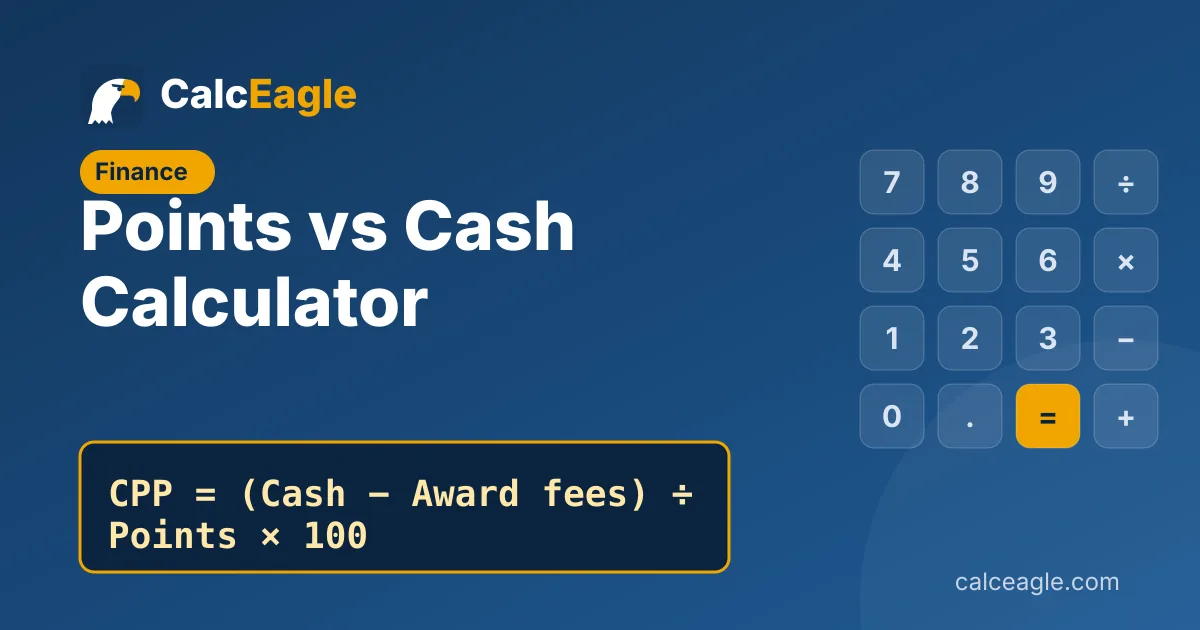
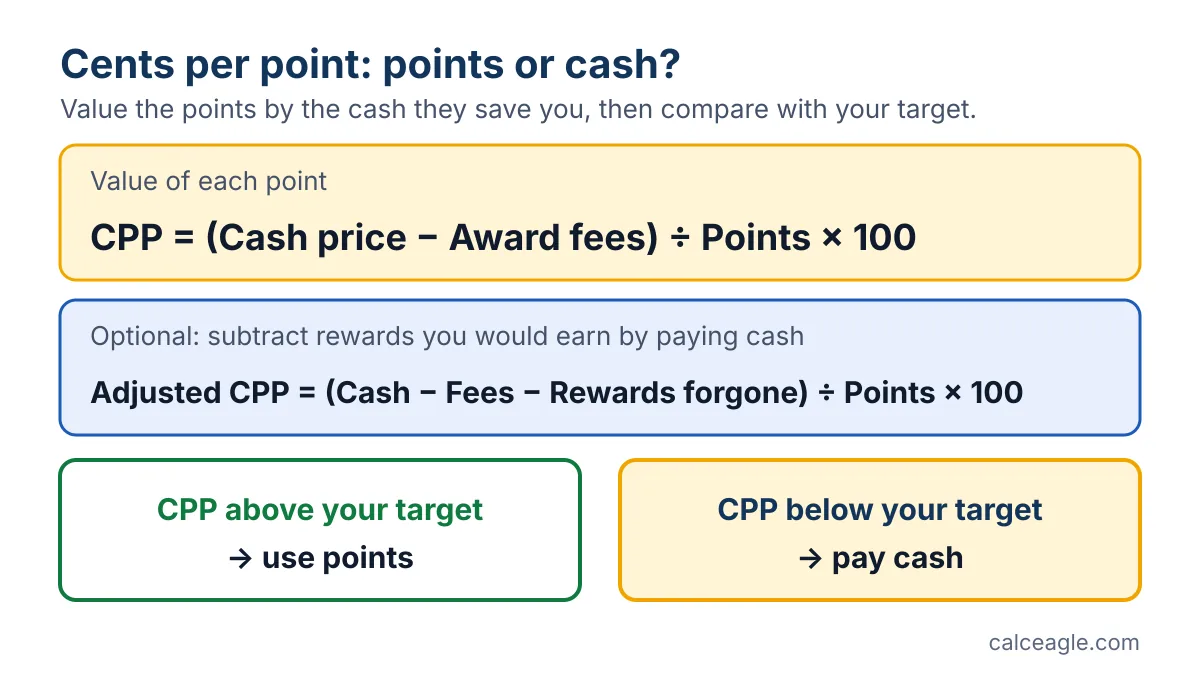
Cents per point (CPP) tells you what each point or mile is worth on a specific booking: CPP = (cash price − taxes and fees on the award) ÷ points required × 100. If the result beats the value you set for your points, using points is the better deal. If not, pay cash and keep the points.
For example, a $450 flight or 30,000 points plus $5.60 works out to (450 − 5.60) ÷ 30,000 × 100 = 1.48¢ per point, or 1.38¢ after counting the 2,250 points a paid ticket would have earned.
How to use the points vs cash calculator
- Type a Program name if you like. It only labels the result.
- Enter the Cash price for the exact flight, room or rental you would book, including taxes and mandatory fees.
- Enter the Points required (points or miles) for the same booking.
- Enter the Award taxes & fees: the cash you still pay when you book with points. Use 0 if there are none.
- Optionally enter the Points earned on cash, such as the miles a paid ticket would earn. Leave it blank to skip.
- Enter Your target value per point in cents, the minimum you want each point to be worth. See the section on choosing a target below.
- Press Calculate to see the cents-per-point value, a verdict against your target, the break-even award price and the effective cost of each option.
Points vs cash formula
Cents per point (CPP) measures how much cash each point saves you on one specific booking:
| Term | Meaning |
|---|---|
| Cash saved | Dollars you avoid paying by booking with points |
| × 100 | Converts dollars per point into cents per point |
| Rewards forgone | What the points you would earn on a paid booking are worth, valued at your target |
| Target ¢ | Your own minimum value per point, in cents |
The basic CPP is the standard way to compare redemptions. The adjusted CPP is the fairer number when a paid booking would earn rewards, because using points means giving those up. The calculator values them at your target, so it assumes they are in the same currency you are redeeming. The verdict uses the adjusted figure: use points when it is above your target, pay cash when it is below. The effective-cost comparison gives the same answer in dollars.
Example: a $450 flight
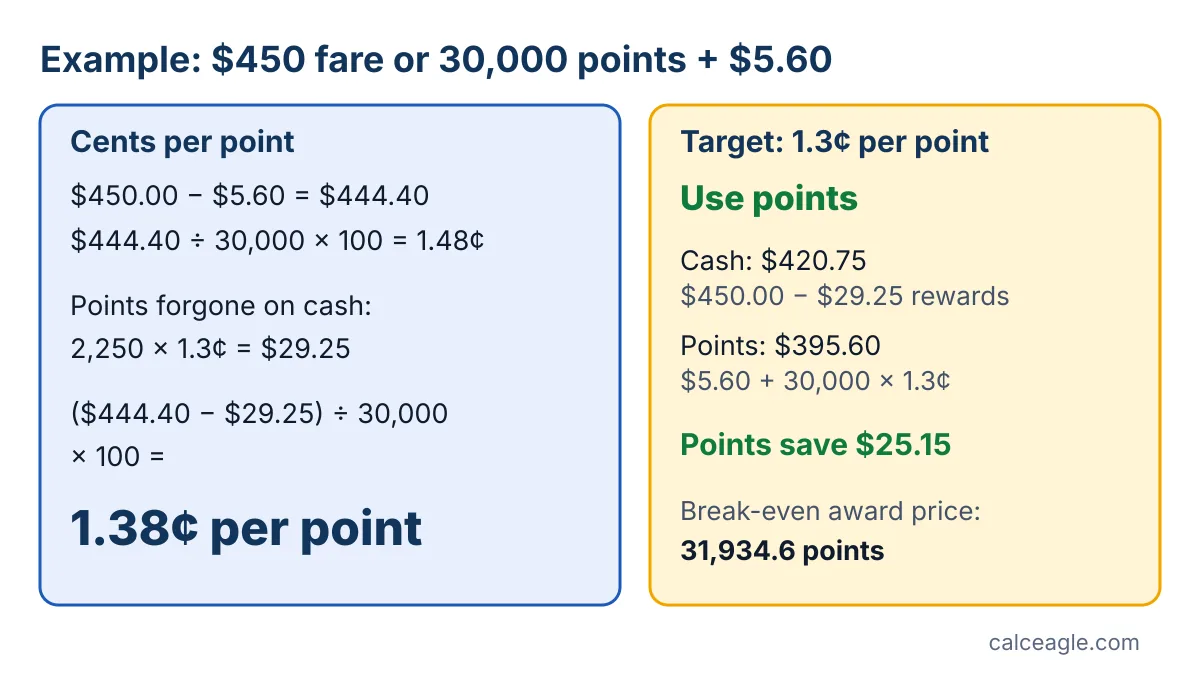
A round-trip fare costs $450 in cash, or 30,000 miles plus $5.60 in taxes and fees. Paying cash would earn 2,250 miles, and you value your miles at 1.3¢ each.
- Cash saved: $450.00 − $5.60 = $444.40.
- Basic CPP: $444.40 ÷ 30,000 × 100 = 1.48¢ per mile.
- Rewards forgone: 2,250 × 1.3¢ = $29.25.
- Adjusted CPP: ($444.40 − $29.25) ÷ 30,000 × 100 = 1.38¢ per mile, which beats the 1.3¢ target.
- Effective cost of paying cash: $450.00 − $29.25 = $420.75.
- Effective cost of using miles: $5.60 + 30,000 × $0.013 = $395.60.
- Using miles saves $420.75 − $395.60 = $25.15 at your valuation.
- Break-even: $415.15 ÷ $0.013 = 31,934.6 miles. If the award cost more than that, paying cash would win.
Without the forgone miles, the comparison looks better than it is: 1.48¢ per mile and $54.40 in savings.
How to choose a target value per point
No regulator sets the value of a point, so the target is your decision. These are common ways to pick one:
- Start with a floor. If your program lets you redeem at a fixed rate for cash back or a statement credit, that rate is the least each point is worth to you. Redeeming below it usually makes little sense. The CFPB notes that a point's value can vary by redemption option and that major issuers typically estimate it at about $0.01 (CFPB).
- Use your own history. Average the CPP of your last few bookings that you would make again.
- Treat published valuations as opinions. Some travel publications post their own point valuations. They differ between sources and change over time, so date any figure you borrow.
- Price in the risk of waiting. The CFPB found that many large issuers reserve the right to change their rewards programs at any time, and consumers report devaluations where redemptions start costing more points. The Department of Transportation notes that airlines generally reserve the right to change frequent flyer terms and that miles expire in some programs (DOT). Points you hold for years may buy less later.
How to read the result
- Value per point (basic) is the cash saved per point before counting any rewards you would earn on a paid booking.
- Value after points you'd earn on cash is the number to compare with your target.
- Break-even award price is the most points the award can cost and still meet your target.
- Effective cost puts both choices in dollars by valuing points at your target. The line underneath shows how much the better option saves.
- A negative value means the award's taxes and fees are higher than the cash price, so paying cash is the better choice.
Assumptions and limitations
- The cash and award options must be the same booking: dates, cabin or room type, and change or cancellation rules.
- Award prices can move. The CFPB reports that many loyalty programs have moved from fixed award charts to dynamic pricing, which makes award costs hard to predict, so compare both prices on the same day.
- Award seats are often limited, according to the DOT, so the cash option may be the only one available for your dates.
- Points you would earn are valued at your target. Elite credits, upgrades and card benefits are not included.
- For hotels, compare the all-in cash rate. The FTC's rule on unfair or deceptive fees, which took effect on May 12, 2025, covers how short-term lodging prices and mandatory fees must be shown (FTC).
Common mistakes
- Leaving out the award's taxes and fees. They reduce the cash you actually save.
- Comparing different products. A refundable fare and a nonrefundable award are not the same purchase.
- Ignoring rewards on the cash booking. They can flip a close call, as in the example.
- Treating a published valuation as a price. Nobody will buy your points at that rate.
- Redeeming below your cash-out floor. If the CPP is lower than your program's fixed cash-back rate, pay cash and redeem the points another way.
Note: Results are estimates for education only, not financial advice. Point values are not set by any regulator, and your target is your own assumption. Award prices, fees and program terms can change at any time, so check both prices right before you book.
Frequently asked questions
How do you calculate cents per point?
Subtract the award's taxes and fees from the cash price, divide by the points required and multiply by 100. A $450 fare versus 30,000 points plus $5.60 is ($450 − $5.60) ÷ 30,000 × 100 = 1.48¢ per point.
What is a good value per point?
There is no official value. A practical floor is the fixed rate your program pays for cash back or statement credits. The CFPB notes that value varies by redemption option and that major issuers typically estimate a point at about one cent. Set a target you are comfortable with and compare each booking against it.
Should I count the points I'd earn by paying cash?
Yes, if a paid booking would earn rewards. Using points means giving those up, so subtract their value from the cash you save. The calculator does this when you enter Points earned on cash.
Why did the points price change when I checked again?
Many loyalty programs now use dynamic award pricing, so the points needed can change with demand. The CFPB has reported consumers seeing award prices change even after refreshing a page, so compare cash and points prices at the same time.
Do airline miles expire?
In some programs, yes. The Department of Transportation lists deadlines for using credits as something to check when choosing a frequent flyer program. Read your program's terms.
Sources and references
- Issue Spotlight: Credit Card Rewards (May 2024) — Consumer Financial Protection Bureau
- Frequent Flyer Programs — U.S. Department of Transportation
- FTC Rule on Unfair or Deceptive Fees to Take Effect on May 12, 2025 — Federal Trade Commission
Formulas and content last reviewed on October 13, 2026. Last updated October 13, 2026. Results are estimates for general information only. Spotted a problem? Tell us and we will check it.