Cow Gestation Calculator
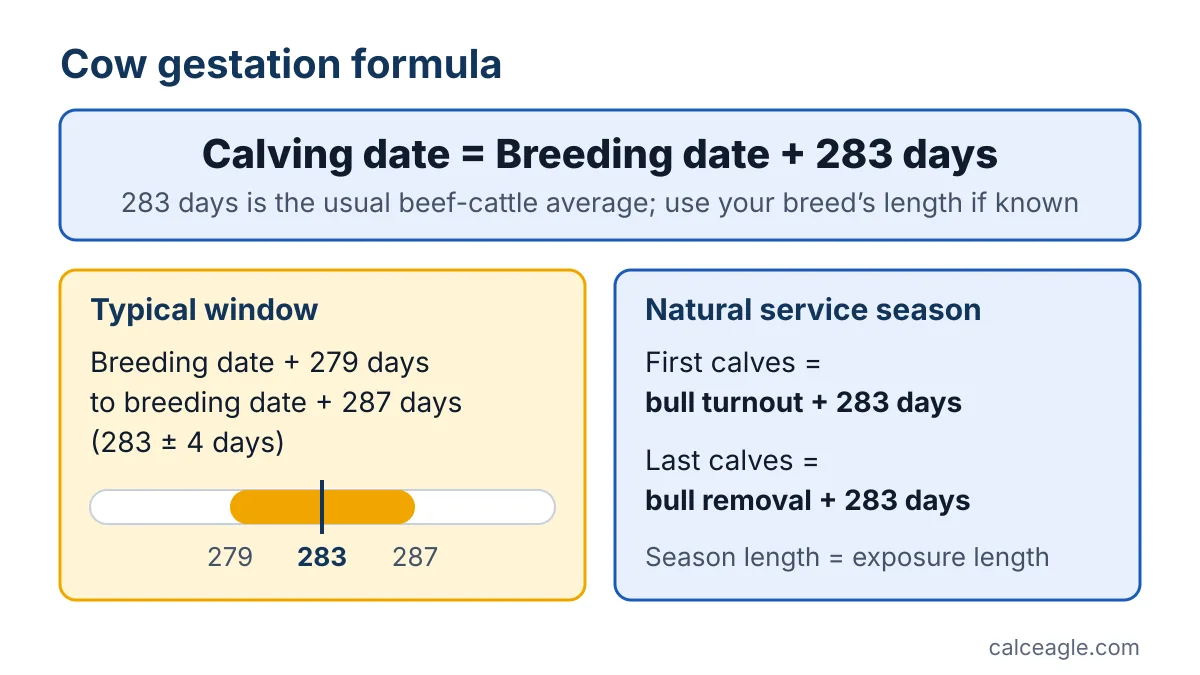
A cow's gestation lasts about 283 days for most beef cattle, with a usual range of 279 to 287 days, so the expected calving date is the breeding date plus 283 days. For example, a cow bred by AI on Monday, June 1, 2026 is due Thursday, March 11, 2027 (03/11/2027).
This cow gestation calculator works from a single breeding or AI date or a whole bull exposure period, offers beef and dairy breed averages, and lists pregnancy-check and calving-check dates.
How to use the Cow Gestation Calculator
- Choose One breeding or AI date for artificial insemination or a single observed mating, or Bull exposure period if the bull ran with the cows for several weeks.
- Enter the Breeding or AI date, or the Bull turnout date and Bull removal date.
- Pick a Breed or type. This fills in the Gestation length, which you can still edit if you know your herd's own average.
- Set the Calving window (± days). The default of 4 days matches the 279- to 287-day range commonly cited for beef cows.
- Press Calculate. You get the expected calving date, the window, calendar days remaining from today, and key dates for pregnancy checks and calving checks.
Cow gestation formula
| Term | Meaning |
|---|---|
| Breeding date | The day of artificial insemination or the observed mating (day 0) |
| Gestation length | Average days from conception to calving for the breed or type |
| Turnout / removal | The first and last days the bull is with the cows |
| Calendar days remaining | Whole days between today's date and the expected calving date |
Gestation length by breed and type
Cooperative Extension beef specialists put cattle gestation at 279 to 287 days, with 283 days common for most breeds. Breed, the calf's sex and the dam's age all shift it. Cows carrying bull calves tend to carry slightly longer, and first-calf heifers tend to calve slightly sooner than mature cows.
| Breed or type | Average gestation | Source |
|---|---|---|
| Beef cattle, most breeds | about 283 days (range 279–287) | Cooperative Extension |
| Brahman-sired crossbred calves | 292.0–293.1 days (Hereford sires 285.7, Angus 283.7) | USDA Meat Animal Research Center |
| Holstein | 277.8 first-calf heifers / 279.4 cows | USDA-ARS dairy study |
| Jersey | 278.4 / 280.0 | USDA-ARS dairy study |
| Milking Shorthorn | 279.3 / 281.1 | USDA-ARS dairy study |
| Ayrshire | 281.6 / 281.7 | USDA-ARS dairy study |
| Guernsey | 284.8 / 285.7 | USDA-ARS dairy study |
| Brown Swiss | 287.2 / 287.5 | USDA-ARS dairy study |
The breed presets round these averages to whole days. The dairy figures come from a USDA Agricultural Research Service analysis of more than 11 million U.S. calvings (1999–2006); the Brahman figures are for calves sired by Brahman bulls out of Angus, Hereford and composite cows, not purebred Brahmans.
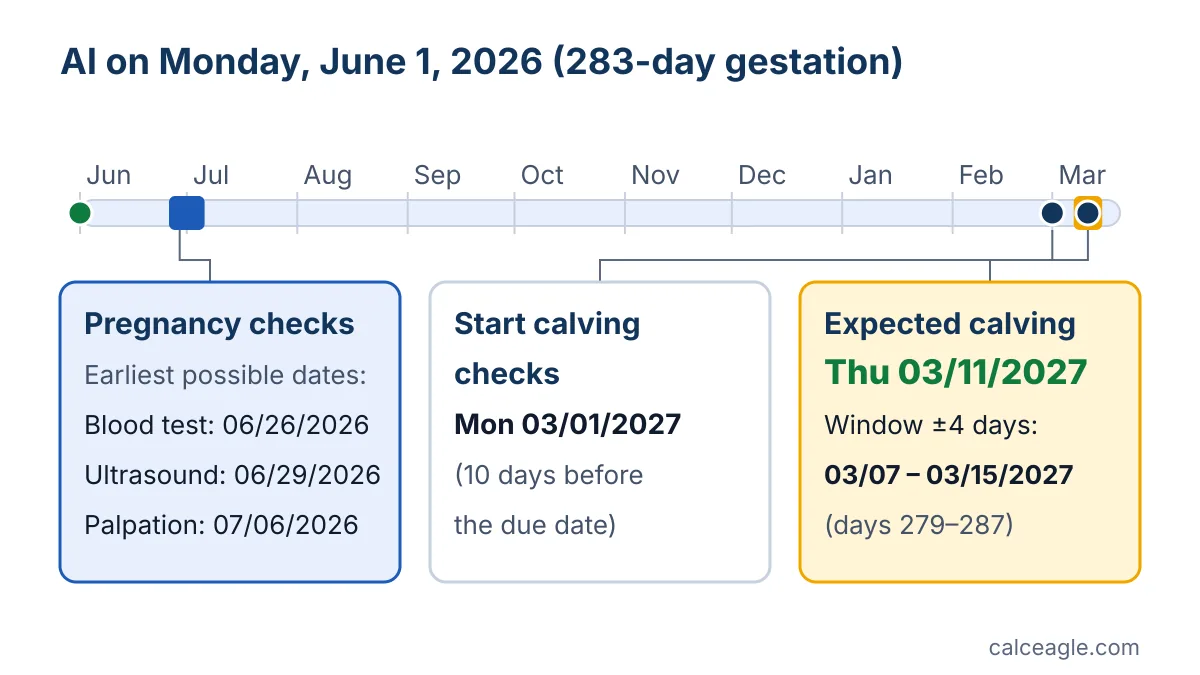
Example: AI on June 1, 2026
A beef cow is artificially inseminated on Monday, June 1, 2026, and you use the typical 283-day gestation.
- Count forward: June has 29 days left after the 1st, then July (31), August (31), September (30), October (31), November (30), December (31), January (31) and February 2027 (28). That reaches 272 days on February 28, 2027.
- Eleven more days gives day 283: Thursday, March 11, 2027 (03/11/2027).
- The ±4-day window runs from Sunday, March 7 to Monday, March 15, 2027 (days 279 to 287).
- The earliest pregnancy checks fall on June 26 (blood or milk test, day 25), June 29 (ultrasound, day 28) and July 6, 2026 (rectal palpation, day 35).
- Start routine calving checks 10 days early, on Monday, March 1, 2027.
Natural service version. If the bull goes in on June 1 and comes out on July 31, 2026 (61 days of exposure, counting both dates), cows that settle on the first day should calve around March 11, 2027, and cows bred on the last day around May 10, 2027. To include those late-bred cows, an ultrasound check should wait until at least August 28, 2026 (28 days after bull removal), or September 4, 2026 for palpation.
Calendar days, gestation days and days remaining
- The calculator treats the breeding day as day 0, so the day after breeding is day 1 and the expected calving date is day 283. If you compare with a printed gestation table, check whether it counts the breeding day as day 0 or day 1; the second method gives dates one day earlier.
- Calendar days remaining is the number of whole calendar days from today's date on your device to the expected date. It ignores the time of day, and date math is done in UTC, so daylight saving time changes never add or lose a day.
- Leap years matter. 283 days after June 15, 2027 is March 24, 2028, one day earlier on the calendar than 283 days after June 15, 2026 (March 25, 2027), because February 29, 2028 is counted.
How to read the result
- The expected calving date is an average, not a deadline. Oklahoma State University specialists note that roughly half of cows calve before the average date and recommend starting routine checks at least a week to 10 days before the first expected calving.
- The window is where most calvings fall when the herd's average matches the gestation length you entered. Widen it if your records show more spread.
- Key dates show how far each milestone is from today, so you can plan vet visits and move cows to the calving area in time.
Assumptions and limitations
- One gestation length is applied to every cow. Individual cows vary, and twins come early: in the USDA dairy study, Holstein cows carrying same-sex twins calved 4.7 to 5.6 days sooner than cows with single calves.
- Weather can shift timing. In an Oklahoma State study, fall-calving cows that finished pregnancy in late-summer heat carried 4 to 6 days shorter than cows calving in cooler weather.
- Pregnancy-check dates are the earliest times that University of Missouri Extension reports for skilled practitioners: about 25 days for blood or milk tests, about 28 days for transrectal ultrasound and as early as 35 days for rectal palpation. Your veterinarian may prefer a later check.
- In bull exposure mode, any day from turnout to removal is treated as a possible conception day.
Note: Results are planning estimates, not veterinary advice. Gestation length differs by breed, sire, calf sex, parity and environment. Confirm pregnancy with your veterinarian, and call a veterinarian promptly for any calving difficulty.
Common mistakes
- Using the turnout date for every cow. With natural service, only cows that conceive on the first day calve on the first expected date; the rest follow over a season as long as the exposure period.
- Using 283 days for every breed. Guernsey and Brown Swiss average about 285 to 288 days, and Brahman-sired calves about 292, so a 283-day default can put your dates about 2 to 10 days early.
- Waiting for the due date to start watching. Many cows calve before the average date, so start checks 7 to 10 days ahead.
- Pregnancy-checking the herd too soon after bull removal. A check 2 weeks after the bull comes out cannot confirm cows bred in the last days of the season.
Frequently asked questions
How long is a cow pregnant?
About 283 days for most beef cattle, with a usual range of 279 to 287 days. That is a little over 9 months. Some breeds run longer: Brown Swiss dairy cows average about 287 days and Brahman-sired calves about 292 days.
How do I calculate a cow's due date?
Add the gestation length to the breeding date. With the typical 283 days, a cow bred on June 1, 2026 is due on March 11, 2027. For natural service, add 283 days to both the bull turnout and removal dates to get the calving season.
Do heifers have a shorter gestation than cows?
Usually, slightly. Extension specialists note that first-calf heifers tend to calve sooner than mature cows, and in USDA records for dairy breeds the gap ranged from about 0.1 day (Ayrshire) to 1.8 days (Milking Shorthorn).
How soon can you tell if a cow is pregnant?
According to University of Missouri Extension, blood or milk tests can detect pregnancy as early as about 25 days after breeding, transrectal ultrasound around 28 days, and rectal palpation by a skilled practitioner as early as 35 days.
When should I start watching a cow for calving?
Oklahoma State University specialists recommend starting routine checks at least a week to 10 days before the expected first-calving date, because about half of cows calve before the average date.
Sources and references
- How long does a cow's pregnancy last? — Beef Cattle Extension (Cooperative Extension / extension.org)
- Determination of Pregnancy Status in Beef Herds (G2042) — University of Missouri Extension
- Genetic and environmental factors that affect gestation length in dairy cattle (J. Dairy Sci. 92:2259–2269) — USDA Agricultural Research Service, Animal Improvement Programs Laboratory
- Germplasm Evaluation Program Progress Report No. 14 — USDA-ARS U.S. Meat Animal Research Center
- Summertime temperatures shorten gestation length in fall-calving cows and heifers — Oklahoma State University
Formulas and content last reviewed on October 13, 2026. Last updated October 13, 2026. Results are estimates for general information only. Spotted a problem? Tell us and we will check it.